Topics

Help teams explore data without compromising privacy.
Help teams explore data without compromising privacy.
5 Signs Your Enterprise Analytics Needs Deterministic AI Platform

Published
9 min read
Topics:
Reliable AI
Table of Contents
AI is moving fast in enterprise analytics. Faster than most governance frameworks, faster than most IT teams, and — in many cases — faster than trust can be established. The result? Organizations are deploying AI-powered analytics tools that generate answers quickly, but can't always guarantee those answers are right.
That's not a software problem. It's a category mismatch.
Not all AI is built the same way, and not all analytics problems should be solved with the same kind of AI. Generative and probabilistic models are remarkable tools — but they're designed for a different job. When your analytics environment requires consistency, auditability, and zero tolerance for incorrect outputs, you're not looking for smarter AI. You're looking for the right kind of AI.
That kind is deterministic.
A deterministic AI platform doesn't guess. It computes. The same input always produces the same output, every single time — with a clear, traceable path from query to result. No hallucinations. No drift. No "the model interpreted that differently today."
If you're not sure whether your use case fits, here are five signs it does.
Deterministic vs Probabilistic AI: A Quick Note on the Difference
Before diving in, it's worth being clear on the distinction — because the terms get conflated constantly.
Probabilistic AI (including most generative AI) works by predicting the most likely answer based on patterns learned from training data. It's flexible, powerful, and excellent for open-ended tasks. It's also inherently variable — the same question can produce different answers at different times.
Deterministic AI executes predefined logic. It doesn't predict or approximate. It processes structured inputs through verified rules and returns a guaranteed output. It's not about being creative. It's about being correct.
For a deeper breakdown, see our post on Deterministic VS Gen AI: 10 FAQs to Choose the Right Fit.
Sign 1: Your Business Teams Need Numbers They Can Trust
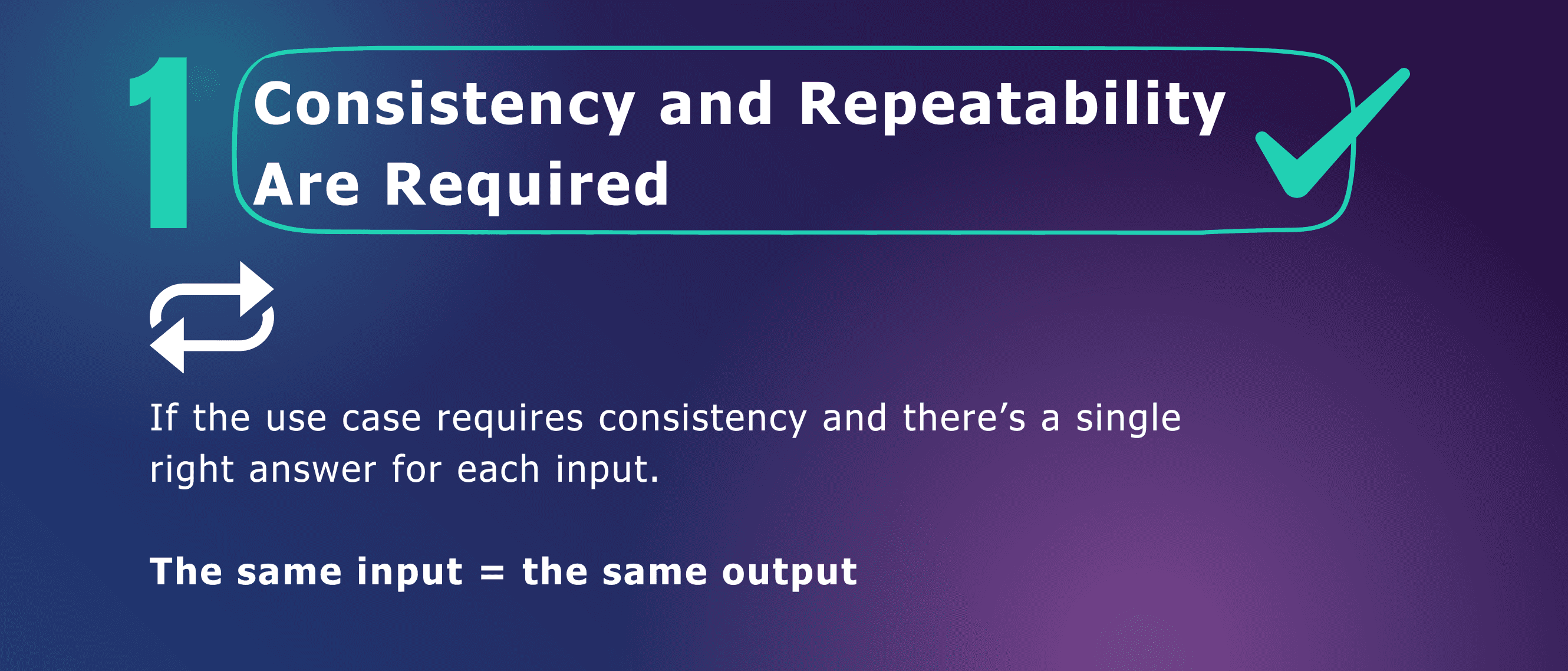
Here's a scenario that happens more often than anyone wants to admit: someone on the sales team pulls a revenue figure on Monday. Someone else pulls the same report on Wednesday. The numbers don't match. Neither person knows which one is right — and now both versions are floating around in email threads and slide decks.
This isn't a data quality issue. It's what happens when a probabilistic system is handling a job that demands deterministic precision.
When business users can't trust that the number they got today is the same number they'll get tomorrow, they stop relying on the tool. They go back to spreadsheets. They ask the data team to verify everything manually. The promise of self-service analytics collapses — not because users aren't capable, but because the foundation isn't reliable enough to build on.
A deterministic AI platform solves this at the source. The same question always returns the same answer, because the system is executing verified logic against your actual data — not making a probabilistic judgment about what the answer probably is. Financial figures, KPI reports, compliance checks: these are not places for approximation. They're places where your business teams need to present a number to a room full of executives and be certain it's right.
Consistency isn't a feature. It's the minimum bar.
Sign 2: Every Decision Must Be Explainable and Auditable
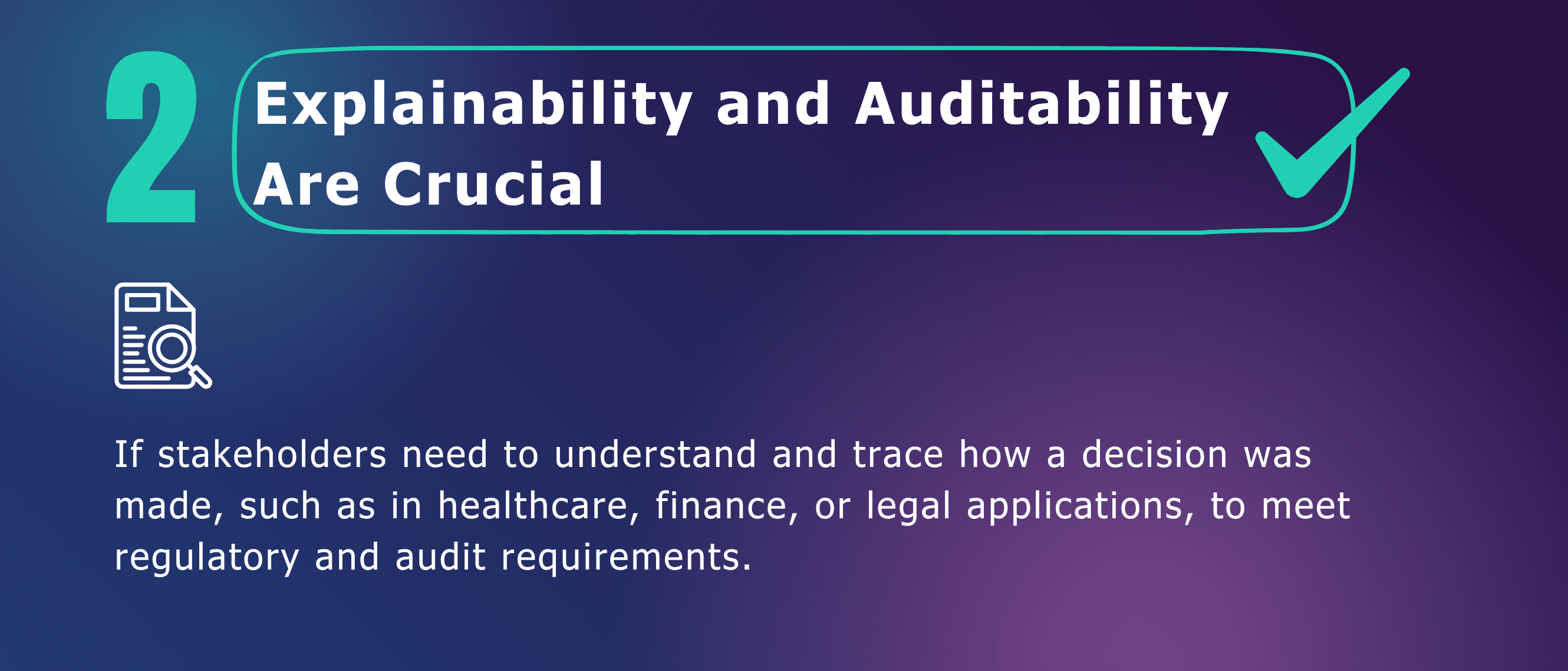
"The AI said so" is not an acceptable answer in a regulatory review. It's also not an acceptable answer for your CFO, your legal team, or your board.
In finance, healthcare, and legal environments, explainability isn't just a product feature — it's a compliance requirement. SOX, HIPAA, and similar frameworks don't just care about the output. They care about how the output was produced, who had access to it, and whether you can demonstrate that the process was sound. A black box — even a highly accurate one — doesn't meet that bar.
Deterministic AI systems produce auditable outputs by design. Every result traces back to a specific chain of logic: the query that was run, the data it touched, the rules that were applied. Nothing is hidden inside a model that can't be inspected. There's no "the weights just work this way" explanation to fall back on.
This matters practically, not just theoretically. When a business analyst questions a KPI figure, they should be able to follow the logic back to its source. Deterministic systems make this straightforward. Probabilistic ones often can't.
Explainability isn't about distrusting AI. It's about building the kind of accountability structure that enterprise environments — especially regulated ones — actually require.
Sign 3: Hallucinations Aren't an Option in High-Stakes Analytics
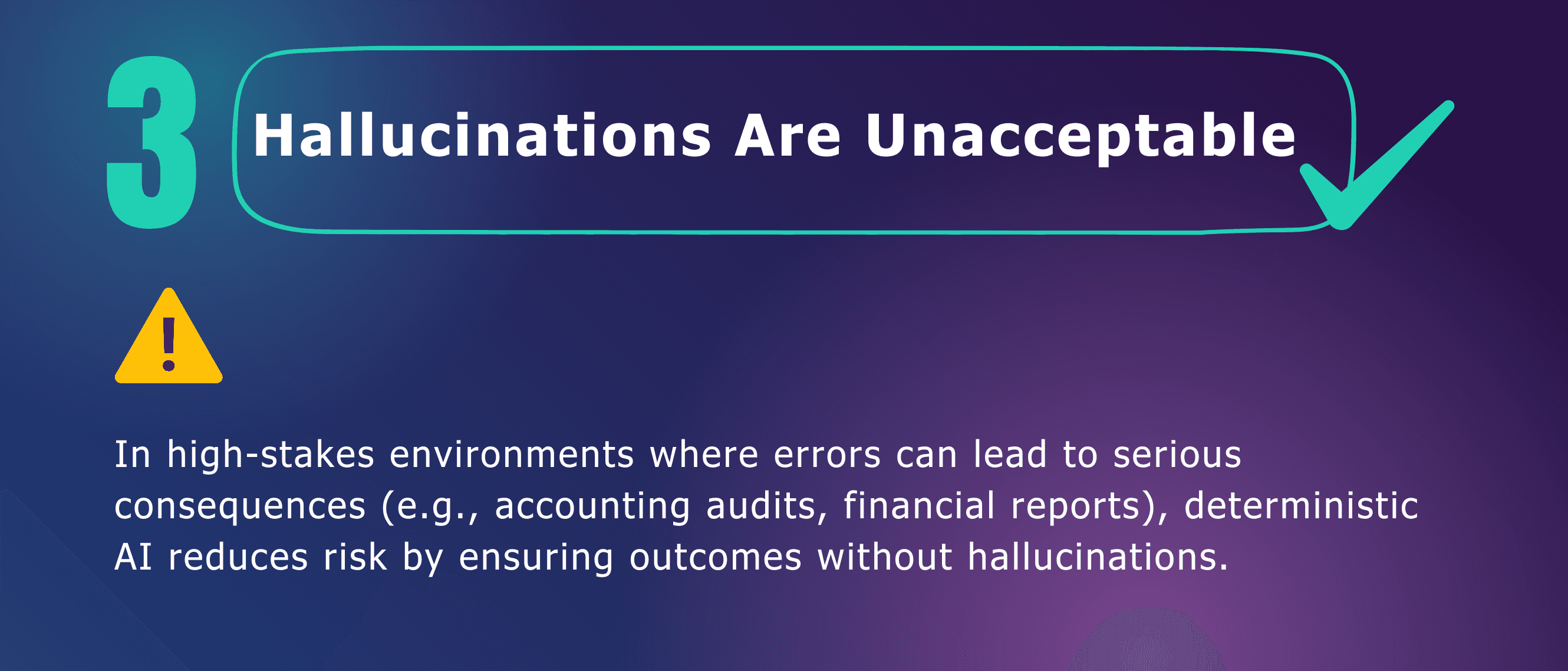
A 5% hallucination rate sounds manageable in isolation. It's not.
In a chained analytics workflow — where one model output feeds the next step, which feeds the next — a 5% error rate doesn't stay at 5%. Across three sequential tasks, your effective accuracy drops to 85.7%. At a 20% error rate, you're operating on outputs that are wrong more than half the time. That's not a quirk of the technology. That's operational risk embedded directly into your decision-making process.
Generative AI is designed to produce plausible outputs. In many contexts, plausible is exactly what you want. In an accounting audit, a financial report, or a safety-critical system, plausible-but-wrong is catastrophic. A hallucinated liquidity ratio. An inventory figure that doesn't exist. A compliance flag that fires on incorrect data — or worse, doesn't fire when it should.

A deterministic AI platform doesn't approximate. It executes verified logic against your actual data and returns a result that is either correct or returns an explicit error. There's no confident-sounding fabrication. There's no output generated from pattern-matching when the data isn't there to support it.
Zero hallucinations isn't a differentiator for deterministic AI. It's the definition of how it works.
Sign 4: Your Data Is Structured — Your AI Platform Should Be Too
Most enterprise analytics runs on databases, data warehouses, and ERP systems. Clean tables. Defined schemas. Numerical fields with known types and relationships. This is structured data — and it's the native environment for a deterministic AI platform.
If your analytics problem looks like send an alert me when inventory drops below threshold, generate the weekly KPI report at 9 AM Monday, or flag every transaction over $10,000 — you're describing a structured, logic-based problem. The inputs are defined. The transformation logic is clear. The expected outputs are known. This is exactly what deterministic AI is built for.
A probabilistic generative model brought into this environment is solving the wrong problem. It's designed for ambiguity, open-ended generation, and tasks without a single correct answer. When your data has a schema and your outputs have defined formats, the flexibility of a generative model doesn't add value — it introduces unnecessary variability into a process that should be locked down.
Deterministic AI isn't limited in a structured data environment. It's precisely fitted to it.
Sign 5: Your Environment Demands Predictable, Controlled AI Behavior
Finance, banking, transportation, healthcare, defence, government IT — these sectors share a common requirement: AI that behaves the same way every time, under controlled conditions, with a complete record of what it did and why.
Generative AI's flexibility is genuinely useful in many contexts. In regulated enterprise environments, that same flexibility becomes a liability. A system that can be prompted into different answers, that drifts based on model updates, or that produces outputs that can't be fully logged and traced is a system that doesn't fit the compliance posture of most enterprise IT governance frameworks.
A deterministic AI platform enforces strict, predictable boundaries. Every query is logged. Outputs are consistent regardless of who runs them or when. Access controls are enforced at the logic layer, not as an afterthought. The system can't be prompted into a different answer because it doesn't work by responding to prompts — it executes logic.
This aligns directly with the requirements of zero-trust architecture, role-based access control, and full audit logging that regulated industries already operate under. Predictable AI behavior isn't a constraint in these environments. It's the entry requirement.
What Makes a Use Case Deterministic?
If you recognized your organization in two or three of these signs, your analytics use case is deterministic in nature. Here's a simple framework to confirm it:
Defined inputs — your data comes from structured sources with known schemas
Structured data — tables, fields, numerical values, and clear relationships
Clear transformation rules — the logic connecting inputs to outputs can be explicitly stated
Expected outputs — results have a known format and a verifiable correct answer
Low ambiguity — the question being asked has a right answer, not a "most likely" answer
When all five of these are true, a probabilistic system isn't just unnecessary — it's working against you.
What to Look for in a Deterministic AI Platform
Not every platform that claims determinism delivers it. When evaluating your options, look for:
Reproducible outputs — same query, same data, same result. Always.
SQL / logic transparency — you can see exactly what query was generated and why
Schema-aware reasoning — the system understands your data model, not just your language
Built-in governance — access controls, logging, and audit trails at the architecture level
Zero hallucinations — not as a guardrail bolted on, but as a structural property of how the system works
Chata.ai is built around exactly these principles. Our deterministic language model translates natural language queries into precise database queries — which means no approximation, no generation, no hallucination risk. Every output is traceable. Every result is reproducible. And the system runs efficiently on standard infrastructure, which means you get enterprise-grade reliability without enterprise-grade GPU costs.
Deterministic AI = foundation for enterprise AI adoption
Not all AI is equal. More importantly, not all analytics problems need the same kind of AI.
If your use case involves structured data, defined business rules, regulated outputs, or decisions that need to be defended to auditors and executives — you need a deterministic AI platform. Not because generative AI isn't powerful, but because power isn't the point. Precision, repeatability, and accountability are.
Deterministic AI is the foundation that enterprise AI adoption in regulated industries is built on. Everything else follows from getting that foundation right.
Ready to see what deterministic analytics looks like in practice? Book a demo with Chata.ai →
Topics
Help teams explore data without compromising privacy.
5 Signs Your Enterprise Analytics Needs Deterministic AI Platform
Published
9 min read
Topics:
Reliable AI
Table of Contents
AI is moving fast in enterprise analytics. Faster than most governance frameworks, faster than most IT teams, and — in many cases — faster than trust can be established. The result? Organizations are deploying AI-powered analytics tools that generate answers quickly, but can't always guarantee those answers are right.
That's not a software problem. It's a category mismatch.
Not all AI is built the same way, and not all analytics problems should be solved with the same kind of AI. Generative and probabilistic models are remarkable tools — but they're designed for a different job. When your analytics environment requires consistency, auditability, and zero tolerance for incorrect outputs, you're not looking for smarter AI. You're looking for the right kind of AI.
That kind is deterministic.
A deterministic AI platform doesn't guess. It computes. The same input always produces the same output, every single time — with a clear, traceable path from query to result. No hallucinations. No drift. No "the model interpreted that differently today."
If you're not sure whether your use case fits, here are five signs it does.
Deterministic vs Probabilistic AI: A Quick Note on the Difference
Before diving in, it's worth being clear on the distinction — because the terms get conflated constantly.
Probabilistic AI (including most generative AI) works by predicting the most likely answer based on patterns learned from training data. It's flexible, powerful, and excellent for open-ended tasks. It's also inherently variable — the same question can produce different answers at different times.
Deterministic AI executes predefined logic. It doesn't predict or approximate. It processes structured inputs through verified rules and returns a guaranteed output. It's not about being creative. It's about being correct.
For a deeper breakdown, see our post on Deterministic VS Gen AI: 10 FAQs to Choose the Right Fit.
Sign 1: Your Business Teams Need Numbers They Can Trust
Here's a scenario that happens more often than anyone wants to admit: someone on the sales team pulls a revenue figure on Monday. Someone else pulls the same report on Wednesday. The numbers don't match. Neither person knows which one is right — and now both versions are floating around in email threads and slide decks.
This isn't a data quality issue. It's what happens when a probabilistic system is handling a job that demands deterministic precision.
When business users can't trust that the number they got today is the same number they'll get tomorrow, they stop relying on the tool. They go back to spreadsheets. They ask the data team to verify everything manually. The promise of self-service analytics collapses — not because users aren't capable, but because the foundation isn't reliable enough to build on.
A deterministic AI platform solves this at the source. The same question always returns the same answer, because the system is executing verified logic against your actual data — not making a probabilistic judgment about what the answer probably is. Financial figures, KPI reports, compliance checks: these are not places for approximation. They're places where your business teams need to present a number to a room full of executives and be certain it's right.
Consistency isn't a feature. It's the minimum bar.
Sign 2: Every Decision Must Be Explainable and Auditable
"The AI said so" is not an acceptable answer in a regulatory review. It's also not an acceptable answer for your CFO, your legal team, or your board.
In finance, healthcare, and legal environments, explainability isn't just a product feature — it's a compliance requirement. SOX, HIPAA, and similar frameworks don't just care about the output. They care about how the output was produced, who had access to it, and whether you can demonstrate that the process was sound. A black box — even a highly accurate one — doesn't meet that bar.
Deterministic AI systems produce auditable outputs by design. Every result traces back to a specific chain of logic: the query that was run, the data it touched, the rules that were applied. Nothing is hidden inside a model that can't be inspected. There's no "the weights just work this way" explanation to fall back on.
This matters practically, not just theoretically. When a business analyst questions a KPI figure, they should be able to follow the logic back to its source. Deterministic systems make this straightforward. Probabilistic ones often can't.
Explainability isn't about distrusting AI. It's about building the kind of accountability structure that enterprise environments — especially regulated ones — actually require.
Sign 3: Hallucinations Aren't an Option in High-Stakes Analytics
A 5% hallucination rate sounds manageable in isolation. It's not.
In a chained analytics workflow — where one model output feeds the next step, which feeds the next — a 5% error rate doesn't stay at 5%. Across three sequential tasks, your effective accuracy drops to 85.7%. At a 20% error rate, you're operating on outputs that are wrong more than half the time. That's not a quirk of the technology. That's operational risk embedded directly into your decision-making process.
Generative AI is designed to produce plausible outputs. In many contexts, plausible is exactly what you want. In an accounting audit, a financial report, or a safety-critical system, plausible-but-wrong is catastrophic. A hallucinated liquidity ratio. An inventory figure that doesn't exist. A compliance flag that fires on incorrect data — or worse, doesn't fire when it should.
A deterministic AI platform doesn't approximate. It executes verified logic against your actual data and returns a result that is either correct or returns an explicit error. There's no confident-sounding fabrication. There's no output generated from pattern-matching when the data isn't there to support it.
Zero hallucinations isn't a differentiator for deterministic AI. It's the definition of how it works.
Sign 4: Your Data Is Structured — Your AI Platform Should Be Too
Most enterprise analytics runs on databases, data warehouses, and ERP systems. Clean tables. Defined schemas. Numerical fields with known types and relationships. This is structured data — and it's the native environment for a deterministic AI platform.
If your analytics problem looks like send an alert me when inventory drops below threshold, generate the weekly KPI report at 9 AM Monday, or flag every transaction over $10,000 — you're describing a structured, logic-based problem. The inputs are defined. The transformation logic is clear. The expected outputs are known. This is exactly what deterministic AI is built for.
A probabilistic generative model brought into this environment is solving the wrong problem. It's designed for ambiguity, open-ended generation, and tasks without a single correct answer. When your data has a schema and your outputs have defined formats, the flexibility of a generative model doesn't add value — it introduces unnecessary variability into a process that should be locked down.
Deterministic AI isn't limited in a structured data environment. It's precisely fitted to it.
Sign 5: Your Environment Demands Predictable, Controlled AI Behavior
Finance, banking, transportation, healthcare, defence, government IT — these sectors share a common requirement: AI that behaves the same way every time, under controlled conditions, with a complete record of what it did and why.
Generative AI's flexibility is genuinely useful in many contexts. In regulated enterprise environments, that same flexibility becomes a liability. A system that can be prompted into different answers, that drifts based on model updates, or that produces outputs that can't be fully logged and traced is a system that doesn't fit the compliance posture of most enterprise IT governance frameworks.
A deterministic AI platform enforces strict, predictable boundaries. Every query is logged. Outputs are consistent regardless of who runs them or when. Access controls are enforced at the logic layer, not as an afterthought. The system can't be prompted into a different answer because it doesn't work by responding to prompts — it executes logic.
This aligns directly with the requirements of zero-trust architecture, role-based access control, and full audit logging that regulated industries already operate under. Predictable AI behavior isn't a constraint in these environments. It's the entry requirement.
What Makes a Use Case Deterministic?
If you recognized your organization in two or three of these signs, your analytics use case is deterministic in nature. Here's a simple framework to confirm it:
Defined inputs — your data comes from structured sources with known schemas
Structured data — tables, fields, numerical values, and clear relationships
Clear transformation rules — the logic connecting inputs to outputs can be explicitly stated
Expected outputs — results have a known format and a verifiable correct answer
Low ambiguity — the question being asked has a right answer, not a "most likely" answer
When all five of these are true, a probabilistic system isn't just unnecessary — it's working against you.
What to Look for in a Deterministic AI Platform
Not every platform that claims determinism delivers it. When evaluating your options, look for:
Reproducible outputs — same query, same data, same result. Always.
SQL / logic transparency — you can see exactly what query was generated and why
Schema-aware reasoning — the system understands your data model, not just your language
Built-in governance — access controls, logging, and audit trails at the architecture level
Zero hallucinations — not as a guardrail bolted on, but as a structural property of how the system works
Chata.ai is built around exactly these principles. Our deterministic language model translates natural language queries into precise database queries — which means no approximation, no generation, no hallucination risk. Every output is traceable. Every result is reproducible. And the system runs efficiently on standard infrastructure, which means you get enterprise-grade reliability without enterprise-grade GPU costs.
Deterministic AI = foundation for enterprise AI adoption
Not all AI is equal. More importantly, not all analytics problems need the same kind of AI.
If your use case involves structured data, defined business rules, regulated outputs, or decisions that need to be defended to auditors and executives — you need a deterministic AI platform. Not because generative AI isn't powerful, but because power isn't the point. Precision, repeatability, and accountability are.
Deterministic AI is the foundation that enterprise AI adoption in regulated industries is built on. Everything else follows from getting that foundation right.
Ready to see what deterministic analytics looks like in practice? Book a demo with Chata.ai →
More Updates