Topics

Help teams explore data without compromising privacy.
Help teams explore data without compromising privacy.
Tableau Alternative: Built for Business Users, Not Just Analysts
Published
6 min read
Topics:
Platform Comparison
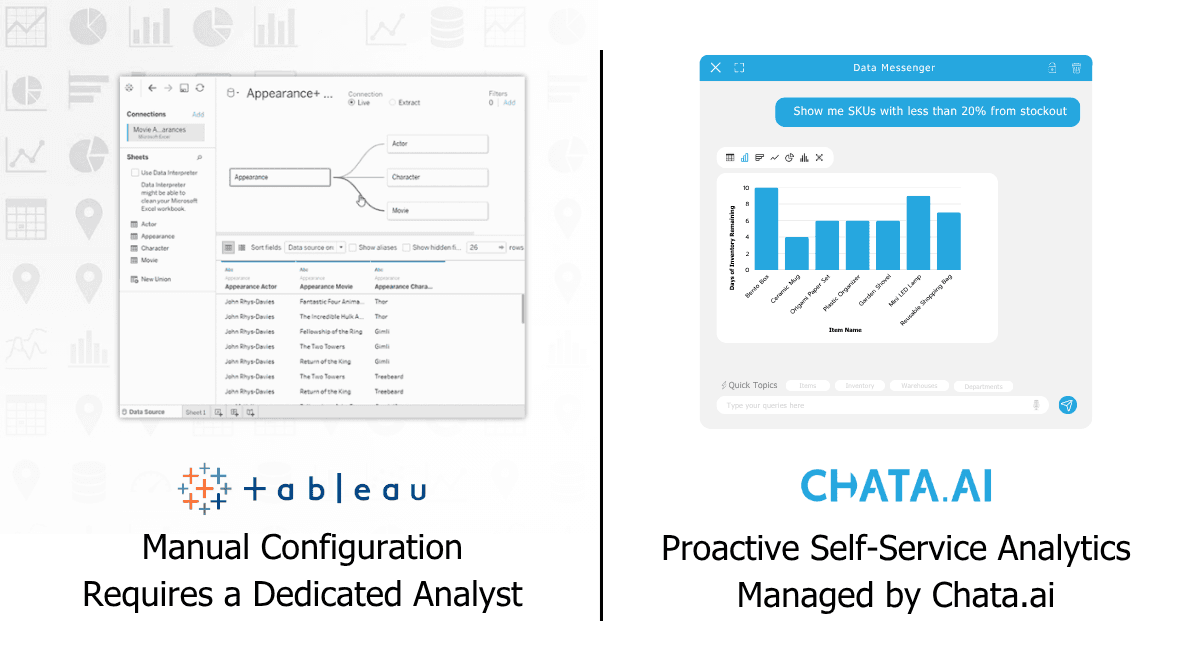
Table of Contents
Tableau was built for a world where analysts are the gateway to insight. That model worked when data lived in a warehouse and dashboards were the finish line. Today's enterprise operates differently. Business users need answers now, from multiple systems, in plain language, not a ticket submitted to the data team.
This is where Tableau hits a wall and Chata.ai was built to take over.
Chata.ai vs. Tableau: Feature Comparison
Feature | Chata.ai | Tableau (Salesforce) |
|---|---|---|
Data Modeling | Custom deterministic language model built automatically from your database schema and business logic. No setup, no maintenance required. | Analysts must manually build and publish a data model before any analysis can take place. |
AI Reliability | Deterministic NLP to SQL engine with a full audit trail. The same question always returns the same answer. | Generative LLM produces probabilistic responses with no way to verify the underlying query logic. |
Data Mapping Accuracy | Connects directly to source data. Automated setup eliminates errors caused by manual field definitions. | Joins are manually configured in the physical layer. Mislabeled fields or misconfigured joins can produce wrong results. |
Alerts & Monitoring | Business users set natural language alerts across multiple sources directly from raw data. | Threshold-based alerts tied to published dashboard views only. No cross-source monitoring. |
Cross-Source Querying | A single natural language prompt pulls from multiple data sources simultaneously, no joins required. | Querying across sources requires analyst-built data blending or pre-joined views. |
Why Enterprises Choose Chata.ai Over Tableau
Proactive Monitoring & Robust Alerts
Business users create natural language alerts directly from source data. No dashboard or published view required. A single alert spans multiple sources with real-time notifications showing the reason behind every number.
Trustworthy & Deterministic AI
Chata.ai's NLP to SQL engine delivers a full audit trail with zero hallucinations. The same question always returns the same answer, traceable back to the exact query logic. Runs on CPU at lower cost than GPU generative models.
Zero Implementation Burden
Chata.ai builds and manages a custom language model automatically. No data sources to build, no joins to configure, no prep flows. When your data changes, Chata.ai retrains and redeploys. Handled entirely by us.
Tableau's Data Model: Built to Be Maintained
Before anyone in your organization can query a single number in Tableau, an analyst has to build and publish a data model. Tableau's architecture requires manually configuring a physical layer (joins and unions) and a logical layer (table relationships). Every LOD expression, calculated field, and relationship is hand-built and hand-maintained.
❌ The Tableau Bottleneck
Schema changes require remapping and republishing. Mislabeled fields or misconfigured joins can return wrong results with no warning surfaced to the user. Business teams are permanently dependent on analysts, and analysts are permanently trapped in maintenance work.
✔️ The Chata.ai Approach
Chata.ai doesn't build a semantic layer — it takes a different approach. We build a custom deterministic language model directly from your database schema and business logic, using the Chata Logic Layer (CLL) and Database Object Model pipeline. This model retrains as your data changes, so there's no data model to review, approve, or republish. Your data team stays focused on the data itself, not on keeping a queue of definitions current.
Deterministic AI vs. Probabilistic Guessing
Tableau Agent, Tableau's AI query layer, is powered by a generative large language model. That means every answer is a probable answer, not a verified one. Poorly named fields, ambiguous joins, and imprecise prompts can return plausible-sounding results that are logically wrong. There is no mechanism for users to verify the underlying query logic.
"The same question asked twice should return the same answer. That is not a preference. It is a requirement for enterprise analytics."
Chata.ai's NLP to SQL engine is deterministic by design. A custom language model is trained specifically on your data's terminology, acronyms, and relationships. Every response is traceable to an exact query. Hallucinations are architecturally impossible, not just minimized.
Proactive Intelligence vs. Reactive Dashboards
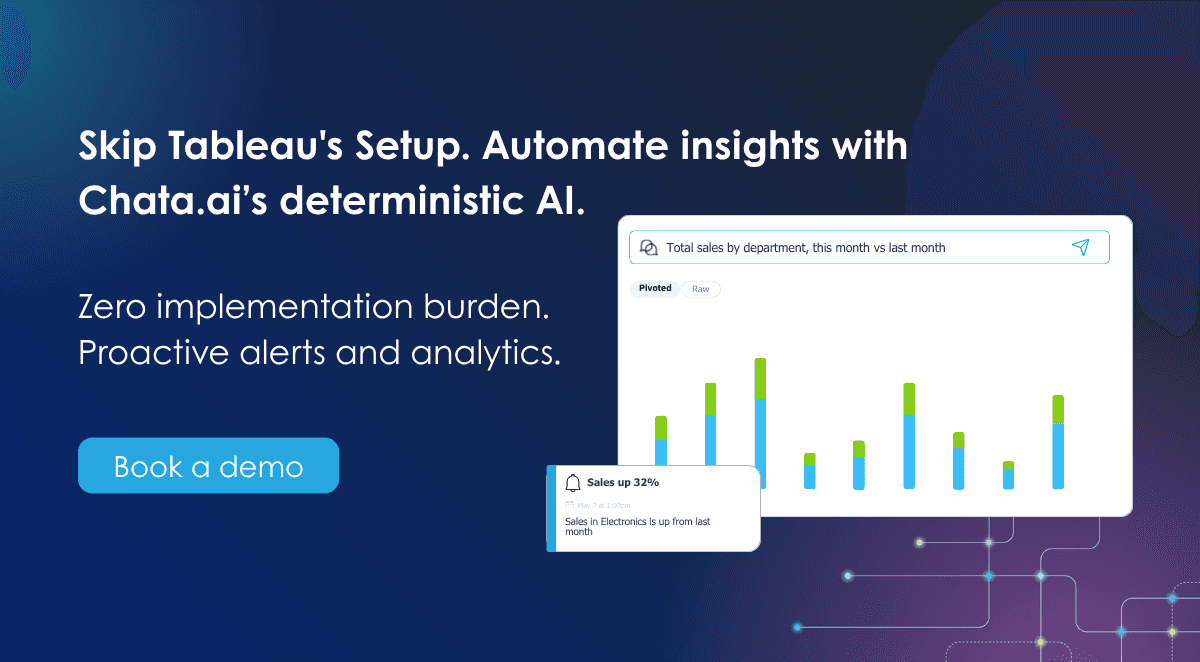
Tableau's alert system is tied to published views on Tableau Server or Cloud. Alerts are threshold-based only, triggered when a numeric value crosses a defined point. Business users cannot create alerts in natural language, and cross-source comparative monitoring is not supported.
Chata.ai changes this by allowing business users to ask a natural language question, for example "What is Q3 revenue from the West region compared to last year?" and then set an alert to notify them if it drops more than 8% week-over-week. No dashboard, no analyst, no SQL required. Alerts run directly from source data, across multiple systems, with real-time notifications that surface the reason behind every change.
✔️ Natural language alert creation with no SQL and no dashboard required
✔️ Comparative and percentage-change alerts across multiple data sources
✔️ Real-time notifications that include the data, so users can view and filter results
✔️ No dependency on published views or Tableau Server infrastructure
Cross-Source Querying Without the Complexity
In Tableau, querying across multiple data sources requires data blending or a pre-built joined source. Both approaches carry documented limitations on aggregation and row-level joins, and neither can be executed by a business user without analyst support.
Chata.ai queries span multiple tables and data sources from a single natural language prompt. No manual joins, no pre-built views, no analyst ticket. Business users get a complete picture even when information lives in entirely different systems, returned in seconds.
Who Should Consider a Tableau Alternative?
Tableau remains a strong tool for analyst teams that live inside the platform and have the resources to build and maintain data models. For organizations where the goal is enterprise-wide analytics access, several critical gaps emerge:
Business users need self-service access, not a data team backlog standing between them and answers
KPI monitoring needs to be proactive, not reliant on someone remembering to check a dashboard
AI outputs must be verifiable, as probabilistic results create compliance and trust risk
Data environments change frequently, making manual model maintenance a full-time job
Data lives in multiple systems, and siloed querying produces incomplete, misleading answers
The Bottom Line
Tableau was designed for a world where analysts are the gatekeepers of insight. Chata.ai was built for the world enterprises actually operate in today, where business users need accurate, proactive intelligence across every system, with no technical overhead and no tolerance for hallucinations.
Chata.ai is SOC 2 and ISO 27001 certified, enterprise-grade by design, and deploys with zero implementation burden on your team. We build a custom deterministic language model automatically from your data, so every answer is deterministic, traceable, and trusted.
If your organization has outgrown the analyst-as-gatekeeper model, it is time to see what proactive self-service analytics looks like. Book a demo with Chata.ai today.
Topics
Help teams explore data without compromising privacy.
Tableau Alternative: Built for Business Users, Not Just Analysts
Published
6 min read
Topics:
Platform Comparison
Table of Contents
Tableau was built for a world where analysts are the gateway to insight. That model worked when data lived in a warehouse and dashboards were the finish line. Today's enterprise operates differently. Business users need answers now, from multiple systems, in plain language, not a ticket submitted to the data team.
This is where Tableau hits a wall and Chata.ai was built to take over.
Chata.ai vs. Tableau: Feature Comparison
Feature | Chata.ai | Tableau (Salesforce) |
|---|---|---|
Data Modeling | Custom deterministic language model built automatically from your database schema and business logic. No setup, no maintenance required. | Analysts must manually build and publish a data model before any analysis can take place. |
AI Reliability | Deterministic NLP to SQL engine with a full audit trail. The same question always returns the same answer. | Generative LLM produces probabilistic responses with no way to verify the underlying query logic. |
Data Mapping Accuracy | Connects directly to source data. Automated setup eliminates errors caused by manual field definitions. | Joins are manually configured in the physical layer. Mislabeled fields or misconfigured joins can produce wrong results. |
Alerts & Monitoring | Business users set natural language alerts across multiple sources directly from raw data. | Threshold-based alerts tied to published dashboard views only. No cross-source monitoring. |
Cross-Source Querying | A single natural language prompt pulls from multiple data sources simultaneously, no joins required. | Querying across sources requires analyst-built data blending or pre-joined views. |
Why Enterprises Choose Chata.ai Over Tableau
Proactive Monitoring & Robust Alerts
Business users create natural language alerts directly from source data. No dashboard or published view required. A single alert spans multiple sources with real-time notifications showing the reason behind every number.
Trustworthy & Deterministic AI
Chata.ai's NLP to SQL engine delivers a full audit trail with zero hallucinations. The same question always returns the same answer, traceable back to the exact query logic. Runs on CPU at lower cost than GPU generative models.
Zero Implementation Burden
Chata.ai builds and manages a custom language model automatically. No data sources to build, no joins to configure, no prep flows. When your data changes, Chata.ai retrains and redeploys. Handled entirely by us.
Tableau's Data Model: Built to Be Maintained
Before anyone in your organization can query a single number in Tableau, an analyst has to build and publish a data model. Tableau's architecture requires manually configuring a physical layer (joins and unions) and a logical layer (table relationships). Every LOD expression, calculated field, and relationship is hand-built and hand-maintained.
❌ The Tableau Bottleneck
Schema changes require remapping and republishing. Mislabeled fields or misconfigured joins can return wrong results with no warning surfaced to the user. Business teams are permanently dependent on analysts, and analysts are permanently trapped in maintenance work.
✔️ The Chata.ai Approach
Chata.ai doesn't build a semantic layer — it takes a different approach. We build a custom deterministic language model directly from your database schema and business logic, using the Chata Logic Layer (CLL) and Database Object Model pipeline. This model retrains as your data changes, so there's no data model to review, approve, or republish. Your data team stays focused on the data itself, not on keeping a queue of definitions current.
Deterministic AI vs. Probabilistic Guessing
Tableau Agent, Tableau's AI query layer, is powered by a generative large language model. That means every answer is a probable answer, not a verified one. Poorly named fields, ambiguous joins, and imprecise prompts can return plausible-sounding results that are logically wrong. There is no mechanism for users to verify the underlying query logic.
"The same question asked twice should return the same answer. That is not a preference. It is a requirement for enterprise analytics."
Chata.ai's NLP to SQL engine is deterministic by design. A custom language model is trained specifically on your data's terminology, acronyms, and relationships. Every response is traceable to an exact query. Hallucinations are architecturally impossible, not just minimized.
Proactive Intelligence vs. Reactive Dashboards
Tableau's alert system is tied to published views on Tableau Server or Cloud. Alerts are threshold-based only, triggered when a numeric value crosses a defined point. Business users cannot create alerts in natural language, and cross-source comparative monitoring is not supported.
Chata.ai changes this by allowing business users to ask a natural language question, for example "What is Q3 revenue from the West region compared to last year?" and then set an alert to notify them if it drops more than 8% week-over-week. No dashboard, no analyst, no SQL required. Alerts run directly from source data, across multiple systems, with real-time notifications that surface the reason behind every change.
✔️ Natural language alert creation with no SQL and no dashboard required
✔️ Comparative and percentage-change alerts across multiple data sources
✔️ Real-time notifications that include the data, so users can view and filter results
✔️ No dependency on published views or Tableau Server infrastructure
Cross-Source Querying Without the Complexity
In Tableau, querying across multiple data sources requires data blending or a pre-built joined source. Both approaches carry documented limitations on aggregation and row-level joins, and neither can be executed by a business user without analyst support.
Chata.ai queries span multiple tables and data sources from a single natural language prompt. No manual joins, no pre-built views, no analyst ticket. Business users get a complete picture even when information lives in entirely different systems, returned in seconds.
Who Should Consider a Tableau Alternative?
Tableau remains a strong tool for analyst teams that live inside the platform and have the resources to build and maintain data models. For organizations where the goal is enterprise-wide analytics access, several critical gaps emerge:
Business users need self-service access, not a data team backlog standing between them and answers
KPI monitoring needs to be proactive, not reliant on someone remembering to check a dashboard
AI outputs must be verifiable, as probabilistic results create compliance and trust risk
Data environments change frequently, making manual model maintenance a full-time job
Data lives in multiple systems, and siloed querying produces incomplete, misleading answers
The Bottom Line
Tableau was designed for a world where analysts are the gatekeepers of insight. Chata.ai was built for the world enterprises actually operate in today, where business users need accurate, proactive intelligence across every system, with no technical overhead and no tolerance for hallucinations.
Chata.ai is SOC 2 and ISO 27001 certified, enterprise-grade by design, and deploys with zero implementation burden on your team. We build a custom deterministic language model automatically from your data, so every answer is deterministic, traceable, and trusted.
If your organization has outgrown the analyst-as-gatekeeper model, it is time to see what proactive self-service analytics looks like. Book a demo with Chata.ai today.
More Updates