Topics

Help teams explore data without compromising privacy.
Help teams explore data without compromising privacy.
The ThoughtSpot Alternative That Doesn't Require an Engineering Team
Published
9 min read
Topics:
Platform Comparison
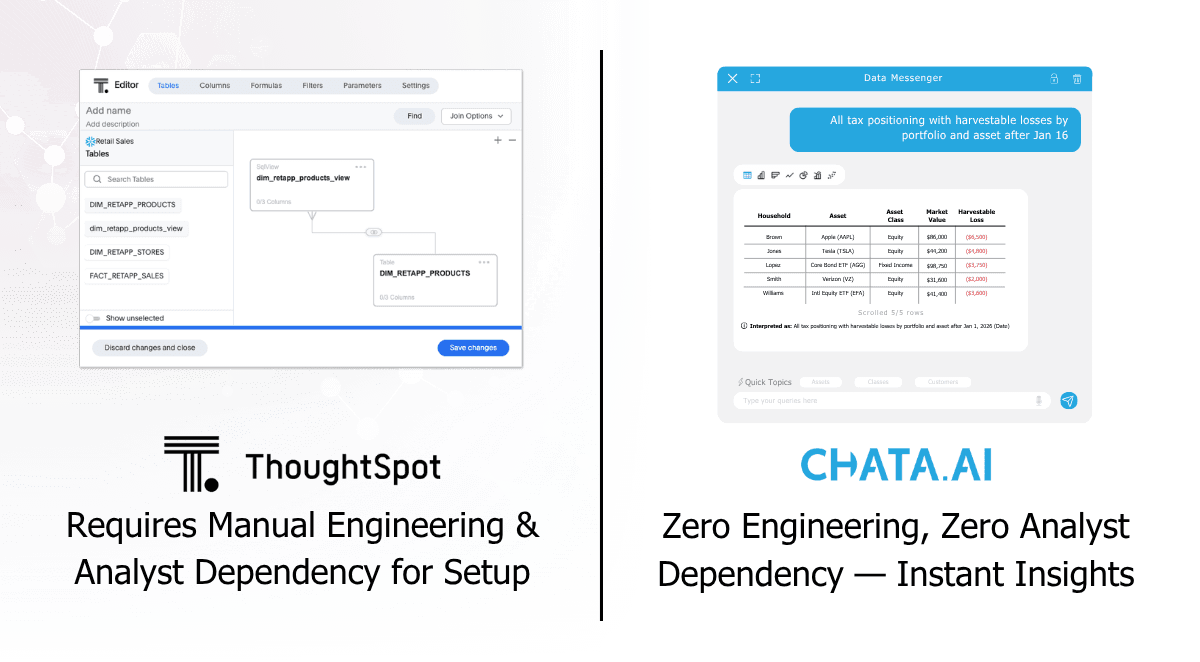
Table of Contents
Your team took countless hours implementing ThoughtSpot. Business users still open a ticket every time they need a new question answered. If that sounds familiar, you're not alone. It's the most common complaint we hear from VPs of Analytics and Data Architects evaluating a ThoughtSpot alternative.
Here's why it happens. ThoughtSpot's AI, Spotter, depends on a semantic model that a human has to verify and approve before it can be trusted. Every new table, every renamed field, every business term has to pass through that review before Spotter can answer a question about it. When your schema changes, that review happens again.
Chata.ai starts from a different premise. We don't ask your team to build or review a model at all. Chata.ai builds a custom deterministic language model from the database schema and business logic, which allows us to generate the query, and the database returns the answer, automatically. That's not a faster version of what ThoughtSpot already does. It's a different architecture, built for teams who can't afford to have their people become the bottleneck for every business question.
Quick Comparison: Chata.ai vs. ThoughtSpot
Feature | Chata.ai | ThoughtSpot |
|---|---|---|
Data Modeling | Built and maintained automatically from your schema. | AI-assisted, but requires human-verified definitions. |
AI Reliability | NLP→SQL deterministic engine with a full audit trail and zero hallucinations. The same question always returns the same answer. | Spotter doesn't generate SQL directly; it converts language into search tokens against a human-verified semantic model, and that model determines SQL correctness, so gaps in it affect the answer. |
Accuracy Over Time | Retrains as data changes as it's maintained from your schema. | Depends on how current the verified model is kept. |
Alerts & Monitoring | Natural language, percentage-change, and cross-source monitoring. | Percentage-change and attribute alerts; cross-source needs pre-built joins. |
Cross-Source Querying | Each source read independently, no ETL required. | Requires a joined semantic model. |
Permissions | Role-based or Access Control List (ACL)-based, tied to your system. | Row and column-level security rules defined manually in the Model. |
Data Handling | Connects live to your database via an encrypted, read-only link — no bulk copy of your data, only minimal reference values cached to generate queries. | Live-query connections avoid moving your data into ThoughtSpot's cloud, but sample attribute values are still indexed into ThoughtSpot's environment periodically; import mode moves data in more fully. |
Pricing | $0.05 per outcome, usage-based. | $0.10 per query on the Pro tier, usage-based. |
Zero Engineering Burden
ThoughtSpot has reduced some of the manual lift in building its semantic layer, with AI-assisted modeling tools and native imports from platforms like Snowflake and Databricks. But the underlying object, Worksheets (now called Models), still requires someone to manually add tables, define joins, build formulas, and set filters, even with SpotterModel assisting. And the model still runs on human-verified definitions as a core requirement. Someone has to review and approve the business logic before Spotter can be trusted to use it, and that review has to happen again every time the logic changes. It's a curation queue, even if it's a shorter one than it used to be.
Chata.ai skips the curation step entirely. We build a custom deterministic language model directly from your database schema and business logic, using the Chata Logic Layer (CLL) and Database Object Model pipeline, and it retrains automatically as your data changes. There's no model to review, approve, or republish. Your data team stays focused on the data itself, not on keeping a queue of definitions current.
Trustworthy & Deterministic AI
ThoughtSpot and Chata.ai both end up running SQL against your data rather than asking a language model to produce the answer directly. The real difference is what happens along the way, and how many layers stand between a question and a trustworthy answer. ThoughtSpot's determinism depends on a human-verified semantic model staying current and complete. If a definition is missing or stale, the gap doesn't announce itself. In fact, Spotter doesn't generate SQL directly from a question at all. Spotter translates natural language into search tokens grounded in that same semantic layer, and it's the underlying token-based query engine, the same one behind classic keyword Search, that turns those tokens into SQL. That's still an extra translation step built on top of the same human-verified model.
Chata.ai's model is built and maintained automatically from your schema and business logic, so there's no separate verification step standing between a schema change and a trustworthy answer. Every Chata.ai answer comes with a full audit trail back to the exact query that produced it, so the same question returns the same answer every time. Authorized users can view this audit trail in Chata.ai's Integrator portal at any time to verify results.
Who Else Is Betting on This
Sync Insights, a DeFi platform built on Chata.ai's technology, has generated more than 450,000 verified insights on the Canton Network, an environment with partners including Goldman Sachs and BNP Paribas. Sync Insights delivers 24/7 real-time analytics coverage and anomaly detection across the network, along with 100% consistent, repeatable outputs. The same question always returns the same answer, which matters when the cost of a wrong one is real money moving on a live network.
Users define thresholds on fees, reward volumes, transfer activity, or any other metric, and Sync Insights monitors the network continuously, pushing alerts via mobile or in-app notification the moment conditions are met. When something looks off, they find out immediately, not at the end of a reporting cycle.
App providers on Canton get the same visibility. Sync Insights lets them watch metrics like featured transfers, provider weightings, and network traffic continuously, visualize how their application sits within the broader network graph, and receive alerts when transfer volumes shift or marker weights change. It turns what was previously a quarterly analysis exercise into a real-time operational capability.
Proactive Monitoring & Robust Alerts
ThoughtSpot's alerting has expanded to include percentage-change and attribute-level triggers, not just fixed thresholds. But once a metric spans more than one system, cross-source monitoring still depends on those systems already being joined in the semantic model.
Chata.ai lets business users set alerts directly in natural language, from Data Messenger or from a dashboard, including comparative alerts across multiple sources without a pre-built join.
Cross-Source Querying: Fusing Insights, Not Data
Most platforms handle multiple data sources by forcing you to combine them first: ETL pipelines, data migrations, a unified warehouse, and a semantic model to tie it all together before anyone can ask a cross-source question.
Chata.ai takes the opposite approach. Each model reads its own source independently, and correlation happens at the insight layer, not the data layer. A single question can span multiple systems without a ticket, without a warehouse migration, and without an analyst pre-building the joins. We fuse insights, not data.
User-Level Access and Permissions
ThoughtSpot enforces access through row-level and column-level security rules defined manually within the Model, tied to user attributes, roles, or group membership. Someone has to build and maintain those rules, and once set, they apply across search, visualizations, and Spotter's answers alike.
Chata.ai supports user-level authority through role-based or ACL-based access, configured to match your existing environment. We work within the access model your organization already has, rather than asking you to rebuild one from scratch.
Data Security and Architecture Control
ThoughtSpot's security documentation is built around ThoughtSpot Cloud. You choose which data warehouses connect, restrict access down to specific tables and columns, and secure the connection with VPN, private connectivity, or a proxy. Even with a live-query connection, ThoughtSpot periodically pulls sample attribute values into its own environment to power search recommendations and Liveboards, and it also supports an import mode that moves data into ThoughtSpot more fully. ThoughtSpot does offer data residency options so you can choose where your data lives for regional compliance, along with role-based and row/column-level security once a source is connected.
Chata.ai works differently. Instead of a shared cloud service you configure yourself, our team deploys and operates the model directly, with secure access into your existing cloud or data environment. We configure an encrypted, read-only connection between our cloud and your database, so we connect live to your data without bulk-copying it, caching only the minimal reference data needed to generate accurate queries. We handle model training, query generation, and implementation end to end, so you're not pulling engineering or data science resources off other work just to stand this up. The deterministic engine works the same way regardless of deployment, so accuracy and auditability don't change based on where the model runs.
If your organization has strict data-sovereignty requirements, that difference is worth mapping against your own infrastructure before choosing.
Built for Regulated Environments
Both ThoughtSpot and Chata.ai support on-premise deployment, but one of the gaps with ThoughtSpot's on-premise model is that it puts infrastructure provisioning, OS management, and security patching on your team. Chata.ai's deployment options, including on-prem, air-gapped, and edge, are built for teams who need that flexibility without taking on the full infrastructure burden themselves.
Pricing and Cost Predictability
ThoughtSpot's usage-based pricing starts as low as $0.10 per query on its Pro tier. Chata.ai's usage-based pricing is $0.05 per outcome, half the starting cost per interaction.
On ThoughtSpot's per-user tier, that same usage sensitivity shows up differently. At $50 per user per month, the plan includes only 25 Spotter queries per user. Past that, unlimited Spotter is a separate add-on. Even the seat-based plan isn't fully flat once your team starts using the AI.
Part of why Chata.ai can offer a more competitive price is architectural. Most generative AI tools run on GPU infrastructure, which is expensive to provision and run at scale. Chata.ai's deterministic engine runs on CPU instead, cutting compute cost by roughly 500x. It's a big part of why usage-based pricing is sustainable at $0.05 per outcome in the first place.
Choosing the Right Path for Your Data
If you're evaluating ThoughtSpot alternatives, the real question isn't which platform has more features. It's how much curation your team has to do to keep the AI trustworthy, and who's responsible for the infrastructure underneath it.
Chata.ai removes the engineering dependency by generating queries directly from your schema, training a language model on your business logic, and keeping the database, not the AI, responsible for the answer. That means your engineering team stays focused on higher-value work instead of maintaining a semantic layer, and you're not hiring additional headcount just to keep the AI trustworthy. It's backed by SOC 2 and ISO 27001 certification, so you get enterprise-grade security without the drawn-out rollout.
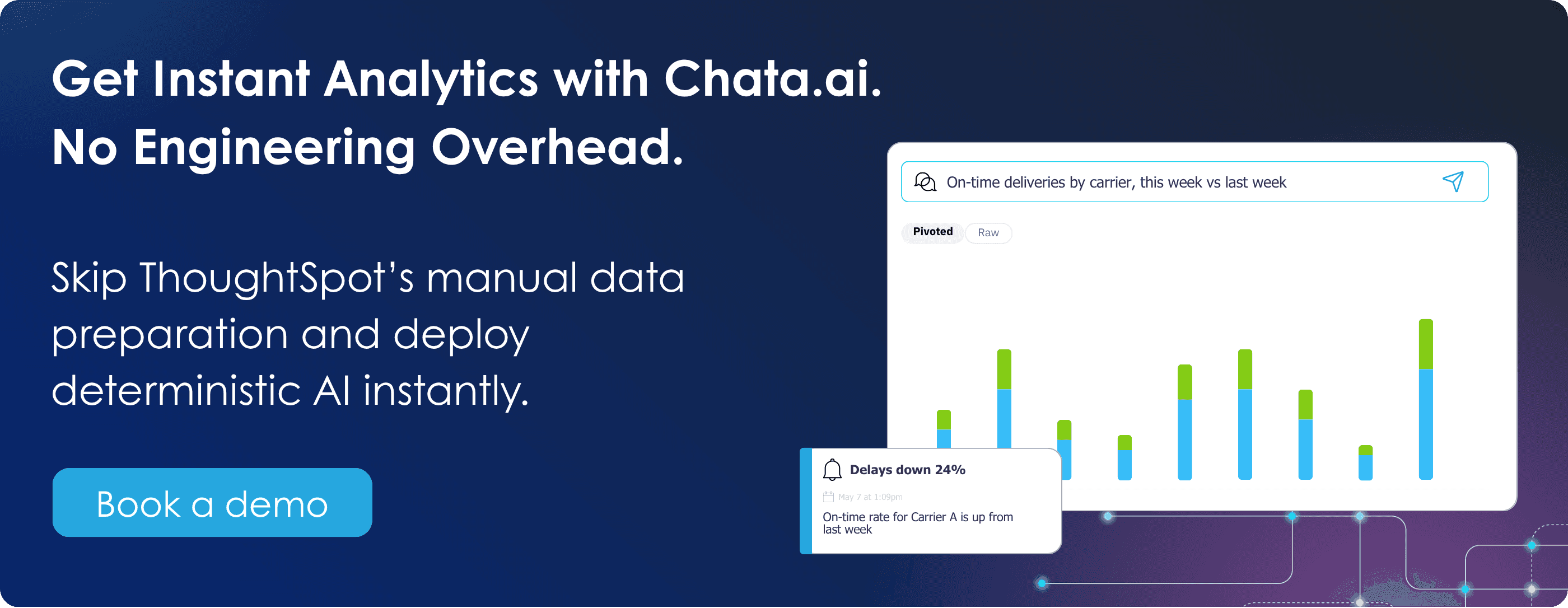
Want to see what this looks like on your own data? Book a demo with Chata.ai.
Topics
Help teams explore data without compromising privacy.
The ThoughtSpot Alternative That Doesn't Require an Engineering Team
Published
9 min read
Topics:
Platform Comparison
Table of Contents
Your team took countless hours implementing ThoughtSpot. Business users still open a ticket every time they need a new question answered. If that sounds familiar, you're not alone. It's the most common complaint we hear from VPs of Analytics and Data Architects evaluating a ThoughtSpot alternative.
Here's why it happens. ThoughtSpot's AI, Spotter, depends on a semantic model that a human has to verify and approve before it can be trusted. Every new table, every renamed field, every business term has to pass through that review before Spotter can answer a question about it. When your schema changes, that review happens again.
Chata.ai starts from a different premise. We don't ask your team to build or review a model at all. Chata.ai builds a custom deterministic language model from the database schema and business logic, which allows us to generate the query, and the database returns the answer, automatically. That's not a faster version of what ThoughtSpot already does. It's a different architecture, built for teams who can't afford to have their people become the bottleneck for every business question.
Quick Comparison: Chata.ai vs. ThoughtSpot
Feature | Chata.ai | ThoughtSpot |
|---|---|---|
Data Modeling | Built and maintained automatically from your schema. | AI-assisted, but requires human-verified definitions. |
AI Reliability | NLP→SQL deterministic engine with a full audit trail and zero hallucinations. The same question always returns the same answer. | Spotter doesn't generate SQL directly; it converts language into search tokens against a human-verified semantic model, and that model determines SQL correctness, so gaps in it affect the answer. |
Accuracy Over Time | Retrains as data changes as it's maintained from your schema. | Depends on how current the verified model is kept. |
Alerts & Monitoring | Natural language, percentage-change, and cross-source monitoring. | Percentage-change and attribute alerts; cross-source needs pre-built joins. |
Cross-Source Querying | Each source read independently, no ETL required. | Requires a joined semantic model. |
Permissions | Role-based or Access Control List (ACL)-based, tied to your system. | Row and column-level security rules defined manually in the Model. |
Data Handling | Connects live to your database via an encrypted, read-only link — no bulk copy of your data, only minimal reference values cached to generate queries. | Live-query connections avoid moving your data into ThoughtSpot's cloud, but sample attribute values are still indexed into ThoughtSpot's environment periodically; import mode moves data in more fully. |
Pricing | $0.05 per outcome, usage-based. | $0.10 per query on the Pro tier, usage-based. |
Zero Engineering Burden
ThoughtSpot has reduced some of the manual lift in building its semantic layer, with AI-assisted modeling tools and native imports from platforms like Snowflake and Databricks. But the underlying object, Worksheets (now called Models), still requires someone to manually add tables, define joins, build formulas, and set filters, even with SpotterModel assisting. And the model still runs on human-verified definitions as a core requirement. Someone has to review and approve the business logic before Spotter can be trusted to use it, and that review has to happen again every time the logic changes. It's a curation queue, even if it's a shorter one than it used to be.
Chata.ai skips the curation step entirely. We build a custom deterministic language model directly from your database schema and business logic, using the Chata Logic Layer (CLL) and Database Object Model pipeline, and it retrains automatically as your data changes. There's no model to review, approve, or republish. Your data team stays focused on the data itself, not on keeping a queue of definitions current.
Trustworthy & Deterministic AI
ThoughtSpot and Chata.ai both end up running SQL against your data rather than asking a language model to produce the answer directly. The real difference is what happens along the way, and how many layers stand between a question and a trustworthy answer. ThoughtSpot's determinism depends on a human-verified semantic model staying current and complete. If a definition is missing or stale, the gap doesn't announce itself. In fact, Spotter doesn't generate SQL directly from a question at all. Spotter translates natural language into search tokens grounded in that same semantic layer, and it's the underlying token-based query engine, the same one behind classic keyword Search, that turns those tokens into SQL. That's still an extra translation step built on top of the same human-verified model.
Chata.ai's model is built and maintained automatically from your schema and business logic, so there's no separate verification step standing between a schema change and a trustworthy answer. Every Chata.ai answer comes with a full audit trail back to the exact query that produced it, so the same question returns the same answer every time. Authorized users can view this audit trail in Chata.ai's Integrator portal at any time to verify results.
Who Else Is Betting on This
Sync Insights, a DeFi platform built on Chata.ai's technology, has generated more than 450,000 verified insights on the Canton Network, an environment with partners including Goldman Sachs and BNP Paribas. Sync Insights delivers 24/7 real-time analytics coverage and anomaly detection across the network, along with 100% consistent, repeatable outputs. The same question always returns the same answer, which matters when the cost of a wrong one is real money moving on a live network.
Users define thresholds on fees, reward volumes, transfer activity, or any other metric, and Sync Insights monitors the network continuously, pushing alerts via mobile or in-app notification the moment conditions are met. When something looks off, they find out immediately, not at the end of a reporting cycle.
App providers on Canton get the same visibility. Sync Insights lets them watch metrics like featured transfers, provider weightings, and network traffic continuously, visualize how their application sits within the broader network graph, and receive alerts when transfer volumes shift or marker weights change. It turns what was previously a quarterly analysis exercise into a real-time operational capability.
Proactive Monitoring & Robust Alerts
ThoughtSpot's alerting has expanded to include percentage-change and attribute-level triggers, not just fixed thresholds. But once a metric spans more than one system, cross-source monitoring still depends on those systems already being joined in the semantic model.
Chata.ai lets business users set alerts directly in natural language, from Data Messenger or from a dashboard, including comparative alerts across multiple sources without a pre-built join.
Cross-Source Querying: Fusing Insights, Not Data
Most platforms handle multiple data sources by forcing you to combine them first: ETL pipelines, data migrations, a unified warehouse, and a semantic model to tie it all together before anyone can ask a cross-source question.
Chata.ai takes the opposite approach. Each model reads its own source independently, and correlation happens at the insight layer, not the data layer. A single question can span multiple systems without a ticket, without a warehouse migration, and without an analyst pre-building the joins. We fuse insights, not data.
User-Level Access and Permissions
ThoughtSpot enforces access through row-level and column-level security rules defined manually within the Model, tied to user attributes, roles, or group membership. Someone has to build and maintain those rules, and once set, they apply across search, visualizations, and Spotter's answers alike.
Chata.ai supports user-level authority through role-based or ACL-based access, configured to match your existing environment. We work within the access model your organization already has, rather than asking you to rebuild one from scratch.
Data Security and Architecture Control
ThoughtSpot's security documentation is built around ThoughtSpot Cloud. You choose which data warehouses connect, restrict access down to specific tables and columns, and secure the connection with VPN, private connectivity, or a proxy. Even with a live-query connection, ThoughtSpot periodically pulls sample attribute values into its own environment to power search recommendations and Liveboards, and it also supports an import mode that moves data into ThoughtSpot more fully. ThoughtSpot does offer data residency options so you can choose where your data lives for regional compliance, along with role-based and row/column-level security once a source is connected.
Chata.ai works differently. Instead of a shared cloud service you configure yourself, our team deploys and operates the model directly, with secure access into your existing cloud or data environment. We configure an encrypted, read-only connection between our cloud and your database, so we connect live to your data without bulk-copying it, caching only the minimal reference data needed to generate accurate queries. We handle model training, query generation, and implementation end to end, so you're not pulling engineering or data science resources off other work just to stand this up. The deterministic engine works the same way regardless of deployment, so accuracy and auditability don't change based on where the model runs.
If your organization has strict data-sovereignty requirements, that difference is worth mapping against your own infrastructure before choosing.
Built for Regulated Environments
Both ThoughtSpot and Chata.ai support on-premise deployment, but one of the gaps with ThoughtSpot's on-premise model is that it puts infrastructure provisioning, OS management, and security patching on your team. Chata.ai's deployment options, including on-prem, air-gapped, and edge, are built for teams who need that flexibility without taking on the full infrastructure burden themselves.
Pricing and Cost Predictability
ThoughtSpot's usage-based pricing starts as low as $0.10 per query on its Pro tier. Chata.ai's usage-based pricing is $0.05 per outcome, half the starting cost per interaction.
On ThoughtSpot's per-user tier, that same usage sensitivity shows up differently. At $50 per user per month, the plan includes only 25 Spotter queries per user. Past that, unlimited Spotter is a separate add-on. Even the seat-based plan isn't fully flat once your team starts using the AI.
Part of why Chata.ai can offer a more competitive price is architectural. Most generative AI tools run on GPU infrastructure, which is expensive to provision and run at scale. Chata.ai's deterministic engine runs on CPU instead, cutting compute cost by roughly 500x. It's a big part of why usage-based pricing is sustainable at $0.05 per outcome in the first place.
Choosing the Right Path for Your Data
If you're evaluating ThoughtSpot alternatives, the real question isn't which platform has more features. It's how much curation your team has to do to keep the AI trustworthy, and who's responsible for the infrastructure underneath it.
Chata.ai removes the engineering dependency by generating queries directly from your schema, training a language model on your business logic, and keeping the database, not the AI, responsible for the answer. That means your engineering team stays focused on higher-value work instead of maintaining a semantic layer, and you're not hiring additional headcount just to keep the AI trustworthy. It's backed by SOC 2 and ISO 27001 certification, so you get enterprise-grade security without the drawn-out rollout.
Want to see what this looks like on your own data? Book a demo with Chata.ai.
More Updates