Topics

Help teams explore data without compromising privacy.
Help teams explore data without compromising privacy.
Deterministic AI Meets Generative AI: The Hybrid Approach to Enterprise Analytics
Published
4 min read
Topics:
Reliable AI
Table of Contents
Enterprise analytics has historically had a trust problem, and an accessibility problem. For years, these two challenges were treated as separate issues requiring separate tools. The reality is that they share a single solution: a hybrid AI architecture that pairs deterministic precision with generative accessibility.
At Chata.ai, deterministic AI is foundational to everything we build. But as customers increasingly ask for natural language summaries alongside their data, we have seen firsthand where a thoughtfully structured hybrid approach delivers genuine value. It is thinking like this that led us to develop Auto Analyze, our summarization feature built on exactly this architecture. This is not about chasing an AI trend. It is about putting each technology where it actually belongs.
Why Deterministic AI Is the Right Foundation for Analytics
Deterministic AI does one thing exceptionally well: it returns the same verified answer every time, pulled directly from the data source.
When AutoQL processes a natural language query, it converts that input into precise database query language and retrieves results directly from the underlying data warehouse. There is no interpretation, no approximation, no guesswork. The output is traceable to its source and fully repeatable. Run the same query today and tomorrow and you will get the same result, provided the underlying data has not changed.
For analytics, this is not a preference, it is a requirement. Business decisions, compliance reporting, and operational planning all depend on numbers being correct. Deterministic AI provides that guarantee. Generative AI, on its own, does not.
This is the architecture Chata.ai was built on, and it remains the non-negotiable foundation of any trustworthy analytics platform.
The Gap: Accurate Data That's Hard to Consume
Deterministic outputs are precise, but they are not always easy to act on.
Tables and structured query results are exactly what a data analyst needs. They are often not what an executive, portfolio advisor, or non-technical business user needs when they are trying to make a fast decision. The data is right, but the format creates friction for the people who are quickly analyzing it.
This is the gap customers are raising. Not a question about whether the data is accurate — they trust that. The question is whether everyone in the organization can extract meaning from it without routing every request through a data team.
Where the LLM Comes In
Once the deterministic layer has pulled verified results from the data warehouse, a large language model (LLM) takes over a specific, bounded job: turning confirmed output into a plain-language summary. Inside Chata.ai’s platform, this is what Auto Analyze does.
This is the critical distinction. The LLM is not querying the database. It is not generating numbers or inferring figures. It receives data that has already been validated by the deterministic layer and converts it into a format that is readable and actionable for non-technical users.
Hallucination risk, the most serious concern with generative AI in analytics contexts, is effectively eliminated because the LLM never touches the source data. It only ever interprets output that AutoQL has already verified.
This is what makes the hybrid approach defensible. Each layer has a defined role, and neither oversteps it.
Why the Order of Operations Matters
The reason this architecture works is the sequence. Deterministic first. Generative second.
Many vendors are moving in the opposite direction — layering natural language interfaces on top of generative models that query data directly. The result is outputs that sound authoritative but cannot be audited, traced, or fully trusted.
Chata.ai's hybrid approach inverts that risk. The query logic is deterministic and repeatable. The LLM receives a verified result set and summarizes it. The boundary between those two stages is what separates a trustworthy hybrid architecture from one that introduces the very hallucination problem it claims to solve.
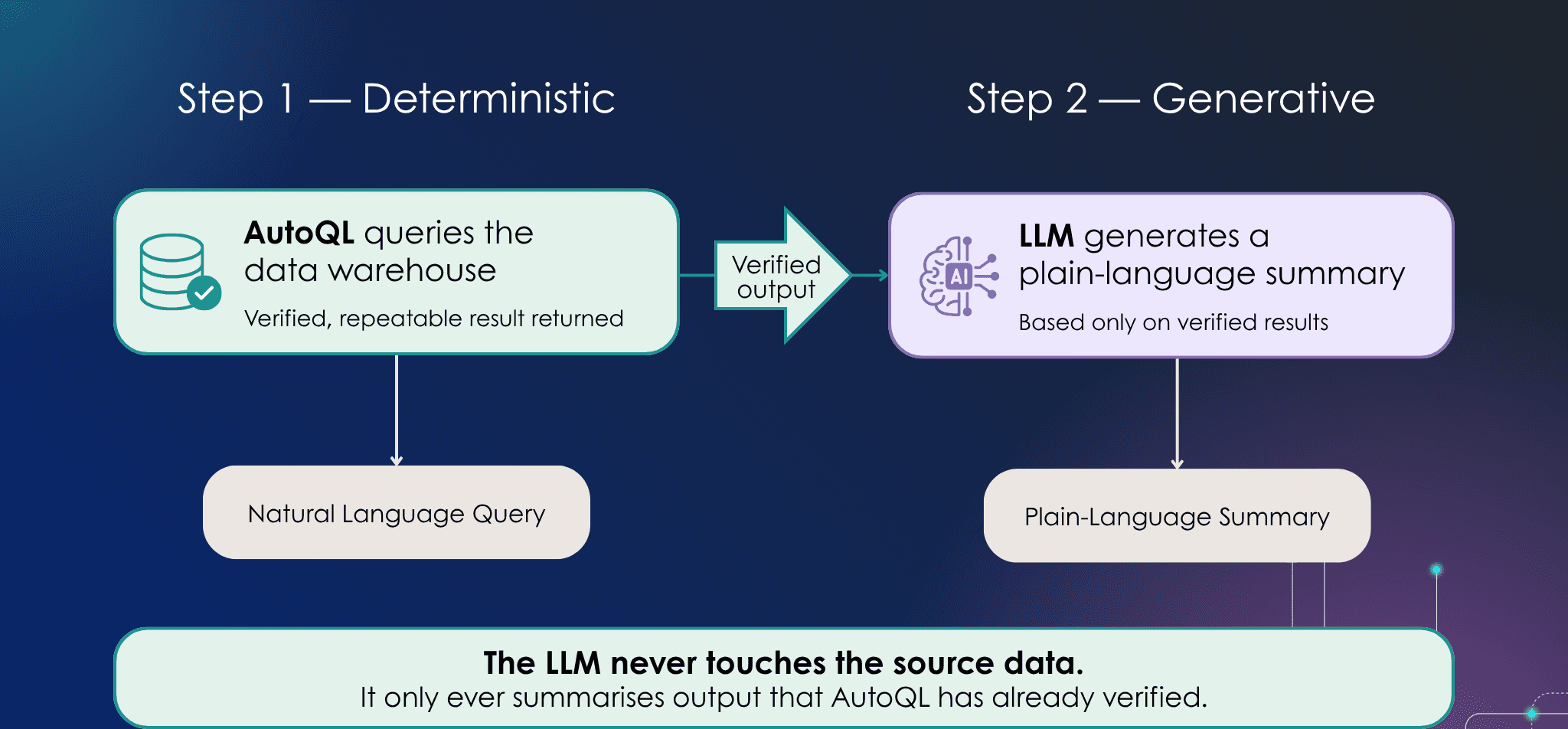
That boundary is not a technical detail. It is the design principle that makes the whole system auditable.
Who This Unlocks Analytics For
This architecture expands who can meaningfully use an analytics platform, not just data teams, but the decision-makers and operators who need answers in real time.
Wealth Management
A portfolio manager or client advisor needs to know how a client's holdings performed last quarter, or flag accounts that have drifted outside their risk tolerance. AutoQL pulls the exact figures from the data warehouse. The LLM summarizes the results in language the advisor can bring directly into a client conversation, without an analyst in the middle.
Decentralized Finance (DeFi)
In DeFi, compliance leads, risk managers, and operations teams need accurate, real-time visibility into on-chain positions, liquidity exposure, and wallet activity. The data exists, but interpreting it quickly and correctly is a challenge for anyone who is not deep in the technical weeds. AutoQL retrieves verified figures directly from the source. The LLM translates those results into a clear summary that business stakeholders can act on without parsing raw transaction data themselves.
Transportation and Logistics
A fleet manager or operations lead tracking route performance, delay patterns, or regional fuel cost trends does not need a full data export. They need the key takeaway. AutoQL retrieves verified operational data from the warehouse. The LLM surfaces the insight in plain language so the transportation manager can act without waiting on a report.
Across any industry, the common thread is the same: the people who need the insight are not always the people equipped to read the raw data. Hybrid AI closes that gap without compromising the integrity of the underlying figures.

Deterministic Accuracy, Generative Accessibility
Hybrid AI is not a compromise between two imperfect approaches. It is a deliberate architecture where each layer does what it does best.
Deterministic AI handles the part that cannot be wrong — the query, the retrieval, the verified result. Generative AI handles the part that benefits from intelligence and nuance — the summary, the plain-language interpretation, the human-readable output.
At Chata.ai, we built on deterministic foundations because accuracy is not optional in enterprise analytics. The hybrid layer exists to make that accuracy accessible to everyone in the organization who needs it.
This is exactly the thinking behind Auto Analyze, Chata.ai's summarization feature that applies the hybrid approach directly inside the platform. Once AutoQL returns a verified result, Auto Analyze generates a plain-language summary of what that data means, no manual interpretation required. It is currently available to select customers on request, with broader availability on the way.
That is what it means to deliver the best of both worlds in enterprise AI analytics.
Ready to give every team in your organization access to accurate, actionable data — without adding headcount or complexity?
Book a demo and see how Chata.ai's hybrid AI approach delivers verified results your business can act on.
Topics
Help teams explore data without compromising privacy.
Deterministic AI Meets Generative AI: The Hybrid Approach to Enterprise Analytics
Published
4 min read
Topics:
Reliable AI
Table of Contents
Enterprise analytics has historically had a trust problem, and an accessibility problem. For years, these two challenges were treated as separate issues requiring separate tools. The reality is that they share a single solution: a hybrid AI architecture that pairs deterministic precision with generative accessibility.
At Chata.ai, deterministic AI is foundational to everything we build. But as customers increasingly ask for natural language summaries alongside their data, we have seen firsthand where a thoughtfully structured hybrid approach delivers genuine value. It is thinking like this that led us to develop Auto Analyze, our summarization feature built on exactly this architecture. This is not about chasing an AI trend. It is about putting each technology where it actually belongs.
Why Deterministic AI Is the Right Foundation for Analytics
Deterministic AI does one thing exceptionally well: it returns the same verified answer every time, pulled directly from the data source.
When AutoQL processes a natural language query, it converts that input into precise database query language and retrieves results directly from the underlying data warehouse. There is no interpretation, no approximation, no guesswork. The output is traceable to its source and fully repeatable. Run the same query today and tomorrow and you will get the same result, provided the underlying data has not changed.
For analytics, this is not a preference, it is a requirement. Business decisions, compliance reporting, and operational planning all depend on numbers being correct. Deterministic AI provides that guarantee. Generative AI, on its own, does not.
This is the architecture Chata.ai was built on, and it remains the non-negotiable foundation of any trustworthy analytics platform.
The Gap: Accurate Data That's Hard to Consume
Deterministic outputs are precise, but they are not always easy to act on.
Tables and structured query results are exactly what a data analyst needs. They are often not what an executive, portfolio advisor, or non-technical business user needs when they are trying to make a fast decision. The data is right, but the format creates friction for the people who are quickly analyzing it.
This is the gap customers are raising. Not a question about whether the data is accurate — they trust that. The question is whether everyone in the organization can extract meaning from it without routing every request through a data team.
Where the LLM Comes In
Once the deterministic layer has pulled verified results from the data warehouse, a large language model (LLM) takes over a specific, bounded job: turning confirmed output into a plain-language summary. Inside Chata.ai’s platform, this is what Auto Analyze does.
This is the critical distinction. The LLM is not querying the database. It is not generating numbers or inferring figures. It receives data that has already been validated by the deterministic layer and converts it into a format that is readable and actionable for non-technical users.
Hallucination risk, the most serious concern with generative AI in analytics contexts, is effectively eliminated because the LLM never touches the source data. It only ever interprets output that AutoQL has already verified.
This is what makes the hybrid approach defensible. Each layer has a defined role, and neither oversteps it.
Why the Order of Operations Matters
The reason this architecture works is the sequence. Deterministic first. Generative second.
Many vendors are moving in the opposite direction — layering natural language interfaces on top of generative models that query data directly. The result is outputs that sound authoritative but cannot be audited, traced, or fully trusted.
Chata.ai's hybrid approach inverts that risk. The query logic is deterministic and repeatable. The LLM receives a verified result set and summarizes it. The boundary between those two stages is what separates a trustworthy hybrid architecture from one that introduces the very hallucination problem it claims to solve.
That boundary is not a technical detail. It is the design principle that makes the whole system auditable.
Who This Unlocks Analytics For
This architecture expands who can meaningfully use an analytics platform, not just data teams, but the decision-makers and operators who need answers in real time.
Wealth Management
A portfolio manager or client advisor needs to know how a client's holdings performed last quarter, or flag accounts that have drifted outside their risk tolerance. AutoQL pulls the exact figures from the data warehouse. The LLM summarizes the results in language the advisor can bring directly into a client conversation, without an analyst in the middle.
Decentralized Finance (DeFi)
In DeFi, compliance leads, risk managers, and operations teams need accurate, real-time visibility into on-chain positions, liquidity exposure, and wallet activity. The data exists, but interpreting it quickly and correctly is a challenge for anyone who is not deep in the technical weeds. AutoQL retrieves verified figures directly from the source. The LLM translates those results into a clear summary that business stakeholders can act on without parsing raw transaction data themselves.
Transportation and Logistics
A fleet manager or operations lead tracking route performance, delay patterns, or regional fuel cost trends does not need a full data export. They need the key takeaway. AutoQL retrieves verified operational data from the warehouse. The LLM surfaces the insight in plain language so the transportation manager can act without waiting on a report.
Across any industry, the common thread is the same: the people who need the insight are not always the people equipped to read the raw data. Hybrid AI closes that gap without compromising the integrity of the underlying figures.
Deterministic Accuracy, Generative Accessibility
Hybrid AI is not a compromise between two imperfect approaches. It is a deliberate architecture where each layer does what it does best.
Deterministic AI handles the part that cannot be wrong — the query, the retrieval, the verified result. Generative AI handles the part that benefits from intelligence and nuance — the summary, the plain-language interpretation, the human-readable output.
At Chata.ai, we built on deterministic foundations because accuracy is not optional in enterprise analytics. The hybrid layer exists to make that accuracy accessible to everyone in the organization who needs it.
This is exactly the thinking behind Auto Analyze, Chata.ai's summarization feature that applies the hybrid approach directly inside the platform. Once AutoQL returns a verified result, Auto Analyze generates a plain-language summary of what that data means, no manual interpretation required. It is currently available to select customers on request, with broader availability on the way.
That is what it means to deliver the best of both worlds in enterprise AI analytics.
Ready to give every team in your organization access to accurate, actionable data — without adding headcount or complexity?
Book a demo and see how Chata.ai's hybrid AI approach delivers verified results your business can act on.
More Updates