Topics

Help teams explore data without compromising privacy.
Help teams explore data without compromising privacy.
The Complete Guide to Deterministic AI Analytics

Published
10 min read
Topics:
Reliable AI
Table of Contents
Deterministic AI analytics is emerging as the answer to a problem most enterprises have learned the hard way: generative AI is powerful, but it's not built for decisions that need to be right every time — reliable, consistent, and verified.
This guide covers everything you need to know about deterministic AI: what it is, how it works, where it outperforms generative tools, which industries need it most, and how to evaluate platforms for enterprise analytics.

What is a Deterministic AI Platform?
A deterministic AI platform is one that produces the same output for the same input, every time. Given identical inputs, a deterministic system follows the same logical path and arrives at the same validated result — no variance, no ambiguity, no surprises.
In analytics, this matters enormously. When your CFO asks "what was our gross margin last quarter?", they need a single, authoritative answer — not a probabilistic estimate that shifts depending on when or how the question is phrased.
Deterministic AI doesn't guess. It translates your question into a structured query, runs it against your governed data, and returns a verified answer — the same way, every time.
Think of it as the difference between a calculator and a chatbot. The calculator doesn't "guess" what 2+2 is. Deterministic AI doesn't guess your Q3 revenue either. It retrieves, validates, and returns verified numbers from your governed data layer.
This is fundamentally different from how generative AI models work — and that difference is why determinism is the only appropriate architecture for business-critical analytics.

→ Read more: How to Choose the Right AI Platform for Enterprise Analytics
The Problem with AI in Analytics
Most AI analytics tools are built on generative foundations — which means they're optimized to sound right, not be right. Every data leader has tried putting an LLM on their database. Almost all of them have pulled it back. The pilot looks promising — until someone uses an AI-generated number to reallocate $500,000 in budget, and six months later finance finds the figures don't match. No audit trail. No way to trace where the number came from. Trust evaporates instantly.
The industry's response has been to build better safety nets — RAG, Agentic RAG, constitutional AI, multi-agent validation. All of them share the same flaw: they try to make a probabilistic system less wrong, rather than fixing the architecture.


→ Why Guardrails Fail in Data Analytics
Deterministic vs. Generative AI: Choosing the Right Tool
Not all AI is built for the same job. Understanding the distinction helps you choose the right tool — and avoid costly mistakes in mission-critical analytics workflows.
Which one will work for your buisness: GenAI, deterministic, or hybrid? Read frequently asked questions and direct answers, covered in depth in our dedicated comparison post linked below.
Capability | Generative AI | Deterministic AI (Chata.ai) |
|---|---|---|
Output consistency | Variable — changes per run | Same answer every time |
Hallucination risk | High — by design | Zero — governed output |
Auditability | Black box | Full query traceability |
Hybrid AI is not a compromise between two imperfect approaches. It is a deliberate architecture where each layer performs the function it is best suited for.
Deterministic AI handles what cannot be wrong: query execution, data retrieval, and verified results from governed sources. Generative AI handles what benefits from flexibility: summarization, explanation, and translating structured outputs into natural, human-readable insights. That's the Chata.ai's approach where determinism and consistency is always key to everything we build.
When Generative AI Makes Sense
Generative AI is the right tool when the cost of being occasionally wrong is low and the value of fluency and flexibility is high. Examples include drafting communications, summarizing documents, generating hypotheses, or exploring unstructured data. The probabilistic nature of LLMs is a feature in these contexts — it enables creativity and nuance.
When Deterministic AI Is Non-Negotiable
Deterministic AI is the right tool when accuracy, repeatability, and auditability are baseline requirements — not nice-to-haves. If the output of an AI query is going to influence a financial decision, appear in a board presentation, drive a pricing change, or be cited in a regulatory filing, probabilistic output is unacceptable. You need a system that can prove it's right, not just seem right.
The Hybrid Consideration
Some organizations find value in both: deterministic AI for structured data queries and financial analytics, generative AI for narrative generation and communication tasks. The key is never routing structured, high-stakes data questions through a probabilistic layer.
Where Accuracy Matters Most in AI Analytics
Not every AI use case requires perfect reproducibility. However, when a wrong number changes a hiring decision, a pricing call, or a quarterly forecast, accuracy isn't a feature — it's the baseline requirement.
A 5% hallucination rate sounds small — until you chain three analytics tasks together and realize your accuracy has dropped to 86%. At 20% error per step, you're at a coin flip. For finance, banking, and operations teams, that's not a quirk. It's a liability.
Not every AI use case requires perfect reproducibility. But in several domains, a wrong number doesn't just cause inconvenience — it causes material harm.
Finance and Accounting
Financial reporting operates on strict accuracy requirements. Variance from audited figures, miscalculated KPIs, or inconsistent period-over-period comparisons can trigger regulatory scrutiny, erode investor confidence, or lead to material misstatements. AI tools used anywhere in the financial data stack must produce verifiable, repeatable outputs.
Banking and Lending
Credit decisions, risk scoring, and portfolio analytics depend on precise, consistent calculations. Hallucinated or inconsistent figures in these workflows create compliance exposure and, in regulated markets, legal liability.
Operations and Supply Chain
Operational decisions — inventory levels, logistics routing, workforce planning — cascade quickly. A single incorrect figure early in a planning cycle can propagate through downstream decisions before anyone catches it. Deterministic AI ensures that the data feeding operational decisions is traceable and correct.
Executive Reporting and Board Presentations
When a VP or C-suite leader presents a number to a board, they are staking their credibility on its accuracy. If that number was generated by a probabilistic AI with no audit trail, the credibility risk is real — and so is the liability if the figure is later found to be wrong.
Regulated Industries
Healthcare analytics, financial services, insurance, and government-adjacent functions often operate under frameworks (SOX, HIPAA, GDPR, Basel III, and others) that require data lineage, access controls, and audit trails. Deterministic AI by Chata.ai satisfies these requirements by architecture.

→ Read more: Deterministic AI in Analytics: When Accuracy Matters Most
How Deterministic AI Works
Most AI systems are built to seem accurate. Deterministic AI is built to prove it. The difference isn't a configuration setting — it's a foundational architectural choice made before a single line of your data is ever touched.
The Core Principle: Generate the Query, Not the Answer
The key insight behind deterministic analytics is simple: instead of asking an AI to generate an answer, you ask it to generate a precise, structured query. That query runs against your actual database. The database produces the result. The database doesn't hallucinate.
This is the architectural principle that separates deterministic platforms from LLM-based analytics tools. The AI's job is translation — from natural language to structured logic — not generation. The data's job is to produce the answer.
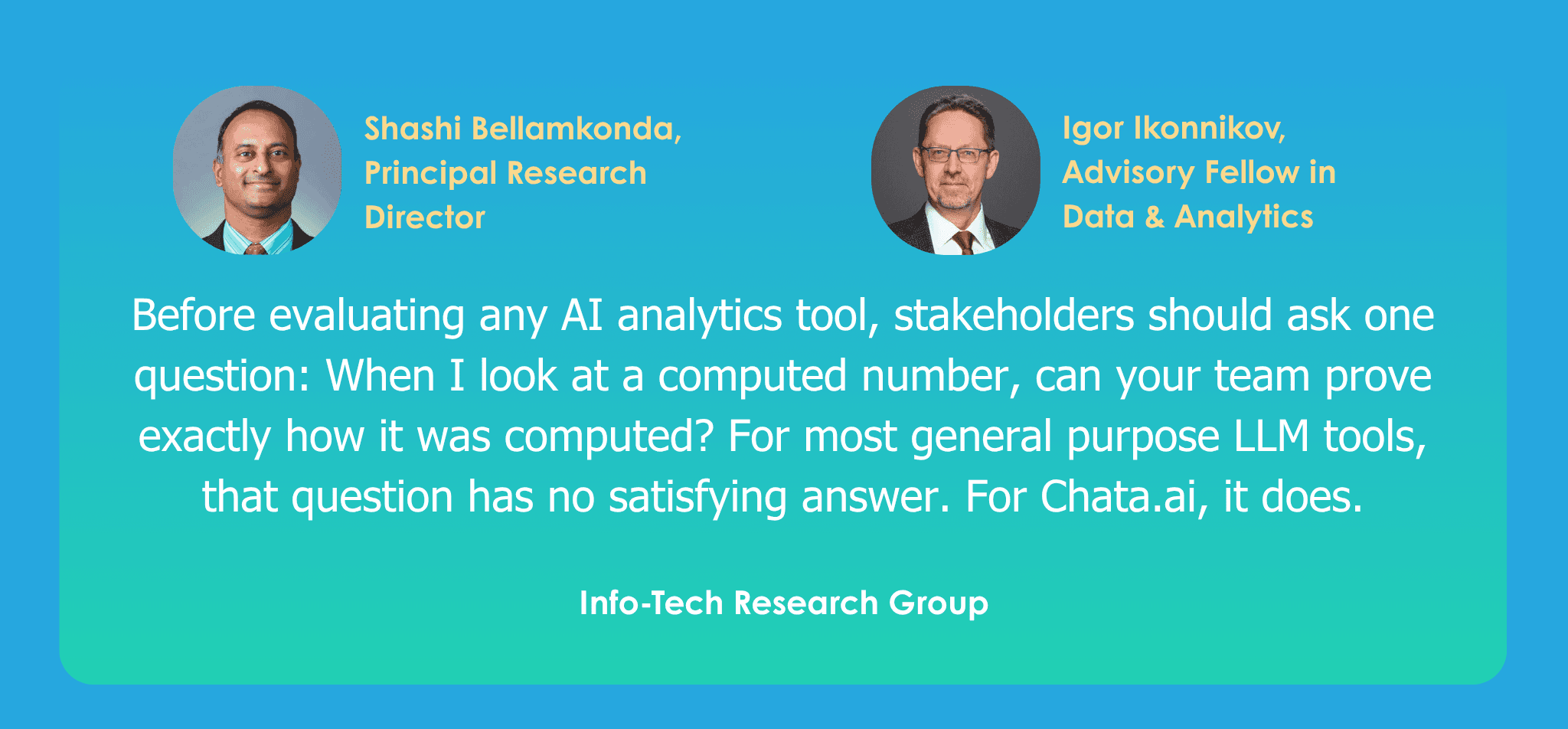
"Chata.ai's deterministic approach addresses a fundamental limitation of generative AI in structured data environments — the inability to guarantee output consistency and provide a verifiable audit trail."
Info-Tech Research Group · Chata.ai: Deterministic AI That Does Not Lie
Step-by-Step: How a Query Flows Through a Deterministic System
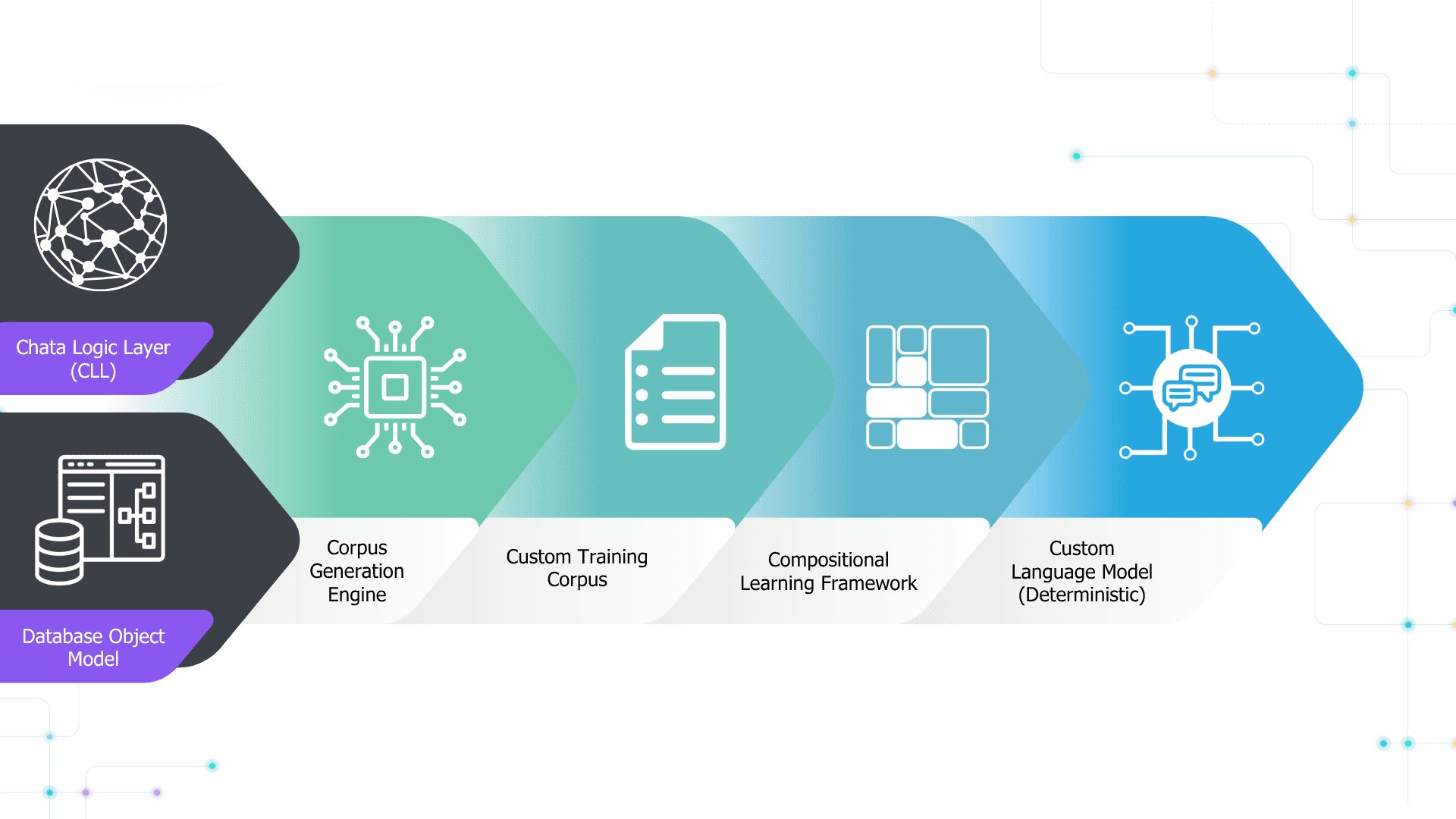
The pipeline starts with two inputs: the Chata Logic Layer (CLL), which encodes how an organization talks about its data, and the Database Object Model — the schema, data types, and table relationships. Critically, the system learns the shape of the data environment, not the data itself. Records never enter training.
Stage 1 — Corpus Generation Engine: Combines those two inputs to build a custom training dataset from the schema and business logic — not general internet data, but a corpus built entirely from the customer's field names, relationships, and terminology.
Stage 2 — Custom Training Corpus: The resulting dataset maps plain-English questions to queryable database structures. Every deployment gets its own corpus.
Stage 3 — Compositional Learning Framework: Breaks a business user's question into component parts and reassembles them into a precise query. This runs on compositional reasoning, not probabilistic inference — no guessing at intent, no drift from phrasing changes, no variation between runs.
Stage 4 — Custom Language Model: Structurally separate from any general-purpose LLM — not a fine-tune, not a wrapper, not retrieval bolted onto a foundation model. It executes standard logic against real data and returns a fully traceable audit trail, a direct byproduct of the architecture rather than a compliance feature.
→ Read more: How Deterministic AI Works: Built to Be Verified
Deterministic AI in Decentralized Finance: The Sync Insights Case
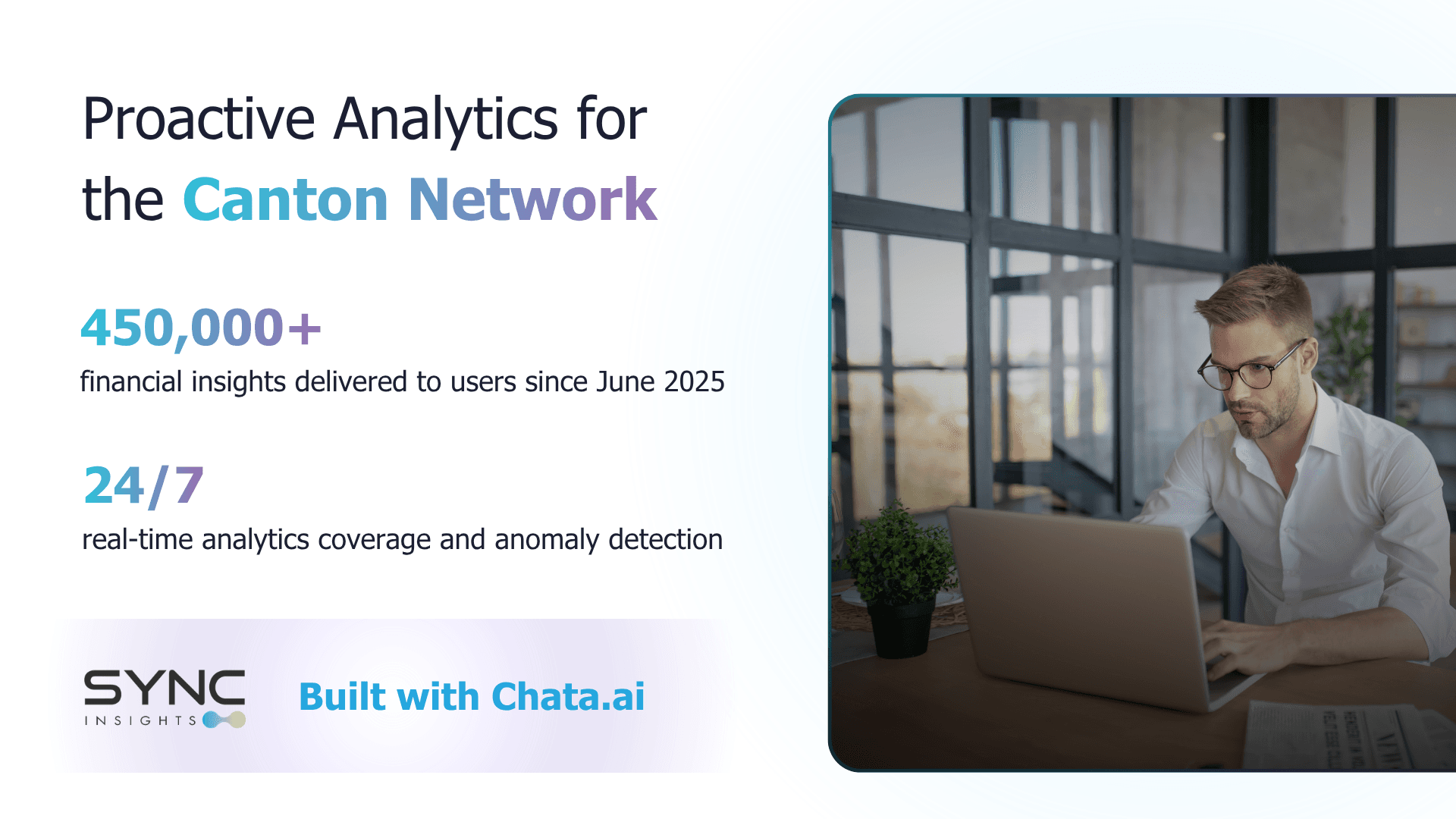
Sync Insights shows what deterministic AI looks like in production. Built on Chata.ai's AutoQL platform, it gives Canton Network participants — validators, app providers, and node operators — the ability to query and monitor financial data in plain language and receive real-time notification when KPIs change. Since June 2025, it has delivered more than 450,000 financial insights with zero hallucinations. Financial institutions and decentralized applications gain trustworthy analytics without exposing sensitive data, because every deployment runs inside the customer's own environment.
Natural-language queries return 100% consistent, auditable answers — the same question always returns the same result.
24/7 proactive monitoring surfaces anomalies and threshold breaches (fees, rewards, transfers) before teams know to look.
The result: real-time operational decisions, reduced reporting delays, compliance-ready analytics.
→ Read more: How Sync Insights Brings Reliable Analytics to the Canton Network
5 Signs Your Enterprise Needs Deterministic AI
Most organizations don't realize they have an analytics trust problem until they're already paying for it — in slow decisions, conflicting reports, or analysts buried in verification work. These five patterns are the clearest signals that your current architecture isn't built for high-stakes decisions.
Your business teams need numbers they can trust. The value of AI analytics evaporates when every output needs a human auditor. Deterministic AI eliminates the verification step because the output is provably correct by construction.
Every decision must be explainable and auditable. Every business-critical number needs a traceable origin — a specific query against a specific dataset at a specific point in time. Deterministic AI provides that trail automatically.
Hallucinations aren't an option in high-stakes analytics. When two people ask the same analytics question and get different answers — because the AI interpreted the phrasing differently, or because probabilistic variation produced different outputs — trust collapses and alignment becomes impossible. Deterministic AI ensures that the same question, asked by anyone, returns the same answer.
Your data is structured — your AI platform should be too. Regulators and internal audit functions increasingly scrutinize how AI-generated data enters decision-making workflows. If your compliance team is raising concerns about AI outputs being used in financial reporting or risk models, the architecture needs to change — not just the guardrails.
Your environment demands predictable, controlled AI behavior. When business teams can't self-serve on data questions — because they don't know SQL, dashboards don't cover their specific needs, or they don't trust AI tools — requests pile up in the analyst queue. Deterministic AI enables trusted self-service: business users can ask questions directly and receive verified answers, without needing an analyst to validate the output.
→ Read more: 5 Signs Your Enterprise Analytics Needs Deterministic AI Platform
How to Choose a Deterministic AI Analytics Platform
The AI analytics market is crowded with tools that market themselves as intelligent, autonomous, and trustworthy — without always delivering on those properties in analytically rigorous ways. Here's what to actually evaluate.
Platform Evaluation Checklist
☐ Reproducible outputs — same query, same data, same result.
☐ Query transparency — you can see exactly what SQL or logic was generated for every answer.
☐ Schema-aware reasoning — the system understands your data model, not just your language.
☐ Governed data sources — answers come from your trusted, structured data only. No model inference filling gaps.
☐ Built-in auditability — full query logs, access controls, and audit trails at the architecture level.
☐ Business-user ready — non-technical users can get trusted answers without analyst involvement.
☐ Stack compatibility — connects to your warehouse, BI tools, and identity/access management without rip-and-replace.
☐ Zero hallucinations by architecture — not a guardrail bolted on, but a structural property of how the system works.
→ See the platform selection guide
Deterministic AI Companies & Solutions
Deterministic AI companies operate across several domains — analytics, IT operations, cloud security, procurement, and infrastructure. They don't all solve the same problem, and not every platform that claims determinism actually delivers it.
The term "deterministic AI" is increasingly used to describe governance layers bolted onto LLMs — which is not the same as a fundamentally deterministic architecture. Knowing what each category of company actually builds is the starting point for making the right choice.
→ See the full breakdown: Deterministic AI Companies — What They Do and How to Choose
How Chata.ai Delivers Deterministic Analytics
Chata.ai is purpose-built as a deterministic AI layer that sits between your business users and your data infrastructure. It doesn't require you to replace your existing stack — it complements it, filling the analytical gaps that dashboards and BI tools were never designed to cover.
What makes Chata.ai different
No hallucinations — every answer is structurally produced from a validated query against your real data. There is no generative layer that could fabricate a result.
Trained on your schema — unlike generic AI models, Chata is trained on the specific structure, terminology, and logic of your data environment.
Direct warehouse connection — Snowflake, BigQuery, Redshift, and more. Real-time access, not cached copies.
Built for business users — zero SQL knowledge required. If you can ask the question, Chata can answer it.
Full auditability — every answer displays the query that produced it. Trace any number back to its source in seconds.
Proactive analytics — Chata can surface anomalies and threshold alerts before your team knows to look for them.
Deterministic AI is not the future of analytics. It's the present — for the organizations that have already chosen accuracy over aspiration.
Topics
Help teams explore data without compromising privacy.
The Complete Guide to Deterministic AI Analytics
Published
10 min read
Topics:
Reliable AI
Table of Contents
Deterministic AI analytics is emerging as the answer to a problem most enterprises have learned the hard way: generative AI is powerful, but it's not built for decisions that need to be right every time — reliable, consistent, and verified.
This guide covers everything you need to know about deterministic AI: what it is, how it works, where it outperforms generative tools, which industries need it most, and how to evaluate platforms for enterprise analytics.
What is a Deterministic AI Platform?
A deterministic AI platform is one that produces the same output for the same input, every time. Given identical inputs, a deterministic system follows the same logical path and arrives at the same validated result — no variance, no ambiguity, no surprises.
In analytics, this matters enormously. When your CFO asks "what was our gross margin last quarter?", they need a single, authoritative answer — not a probabilistic estimate that shifts depending on when or how the question is phrased.
Deterministic AI doesn't guess. It translates your question into a structured query, runs it against your governed data, and returns a verified answer — the same way, every time.
Think of it as the difference between a calculator and a chatbot. The calculator doesn't "guess" what 2+2 is. Deterministic AI doesn't guess your Q3 revenue either. It retrieves, validates, and returns verified numbers from your governed data layer.
This is fundamentally different from how generative AI models work — and that difference is why determinism is the only appropriate architecture for business-critical analytics.
→ Read more: How to Choose the Right AI Platform for Enterprise Analytics
The Problem with AI in Analytics
Most AI analytics tools are built on generative foundations — which means they're optimized to sound right, not be right. Every data leader has tried putting an LLM on their database. Almost all of them have pulled it back. The pilot looks promising — until someone uses an AI-generated number to reallocate $500,000 in budget, and six months later finance finds the figures don't match. No audit trail. No way to trace where the number came from. Trust evaporates instantly.
The industry's response has been to build better safety nets — RAG, Agentic RAG, constitutional AI, multi-agent validation. All of them share the same flaw: they try to make a probabilistic system less wrong, rather than fixing the architecture.
→ Why Guardrails Fail in Data Analytics
Deterministic vs. Generative AI: Choosing the Right Tool
Not all AI is built for the same job. Understanding the distinction helps you choose the right tool — and avoid costly mistakes in mission-critical analytics workflows.
Which one will work for your buisness: GenAI, deterministic, or hybrid? Read frequently asked questions and direct answers, covered in depth in our dedicated comparison post linked below.
Capability | Generative AI | Deterministic AI (Chata.ai) |
|---|---|---|
Output consistency | Variable — changes per run | Same answer every time |
Hallucination risk | High — by design | Zero — governed output |
Auditability | Black box | Full query traceability |
Hybrid AI is not a compromise between two imperfect approaches. It is a deliberate architecture where each layer performs the function it is best suited for.
Deterministic AI handles what cannot be wrong: query execution, data retrieval, and verified results from governed sources. Generative AI handles what benefits from flexibility: summarization, explanation, and translating structured outputs into natural, human-readable insights. That's the Chata.ai's approach where determinism and consistency is always key to everything we build.
When Generative AI Makes Sense
Generative AI is the right tool when the cost of being occasionally wrong is low and the value of fluency and flexibility is high. Examples include drafting communications, summarizing documents, generating hypotheses, or exploring unstructured data. The probabilistic nature of LLMs is a feature in these contexts — it enables creativity and nuance.
When Deterministic AI Is Non-Negotiable
Deterministic AI is the right tool when accuracy, repeatability, and auditability are baseline requirements — not nice-to-haves. If the output of an AI query is going to influence a financial decision, appear in a board presentation, drive a pricing change, or be cited in a regulatory filing, probabilistic output is unacceptable. You need a system that can prove it's right, not just seem right.
The Hybrid Consideration
Some organizations find value in both: deterministic AI for structured data queries and financial analytics, generative AI for narrative generation and communication tasks. The key is never routing structured, high-stakes data questions through a probabilistic layer.
Where Accuracy Matters Most in AI Analytics
Not every AI use case requires perfect reproducibility. However, when a wrong number changes a hiring decision, a pricing call, or a quarterly forecast, accuracy isn't a feature — it's the baseline requirement.
A 5% hallucination rate sounds small — until you chain three analytics tasks together and realize your accuracy has dropped to 86%. At 20% error per step, you're at a coin flip. For finance, banking, and operations teams, that's not a quirk. It's a liability.
Not every AI use case requires perfect reproducibility. But in several domains, a wrong number doesn't just cause inconvenience — it causes material harm.
Finance and Accounting
Financial reporting operates on strict accuracy requirements. Variance from audited figures, miscalculated KPIs, or inconsistent period-over-period comparisons can trigger regulatory scrutiny, erode investor confidence, or lead to material misstatements. AI tools used anywhere in the financial data stack must produce verifiable, repeatable outputs.
Banking and Lending
Credit decisions, risk scoring, and portfolio analytics depend on precise, consistent calculations. Hallucinated or inconsistent figures in these workflows create compliance exposure and, in regulated markets, legal liability.
Operations and Supply Chain
Operational decisions — inventory levels, logistics routing, workforce planning — cascade quickly. A single incorrect figure early in a planning cycle can propagate through downstream decisions before anyone catches it. Deterministic AI ensures that the data feeding operational decisions is traceable and correct.
Executive Reporting and Board Presentations
When a VP or C-suite leader presents a number to a board, they are staking their credibility on its accuracy. If that number was generated by a probabilistic AI with no audit trail, the credibility risk is real — and so is the liability if the figure is later found to be wrong.
Regulated Industries
Healthcare analytics, financial services, insurance, and government-adjacent functions often operate under frameworks (SOX, HIPAA, GDPR, Basel III, and others) that require data lineage, access controls, and audit trails. Deterministic AI by Chata.ai satisfies these requirements by architecture.
→ Read more: Deterministic AI in Analytics: When Accuracy Matters Most
How Deterministic AI Works
Most AI systems are built to seem accurate. Deterministic AI is built to prove it. The difference isn't a configuration setting — it's a foundational architectural choice made before a single line of your data is ever touched.
The Core Principle: Generate the Query, Not the Answer
The key insight behind deterministic analytics is simple: instead of asking an AI to generate an answer, you ask it to generate a precise, structured query. That query runs against your actual database. The database produces the result. The database doesn't hallucinate.
This is the architectural principle that separates deterministic platforms from LLM-based analytics tools. The AI's job is translation — from natural language to structured logic — not generation. The data's job is to produce the answer.
"Chata.ai's deterministic approach addresses a fundamental limitation of generative AI in structured data environments — the inability to guarantee output consistency and provide a verifiable audit trail."
Info-Tech Research Group · Chata.ai: Deterministic AI That Does Not Lie
Step-by-Step: How a Query Flows Through a Deterministic System
The pipeline starts with two inputs: the Chata Logic Layer (CLL), which encodes how an organization talks about its data, and the Database Object Model — the schema, data types, and table relationships. Critically, the system learns the shape of the data environment, not the data itself. Records never enter training.
Stage 1 — Corpus Generation Engine: Combines those two inputs to build a custom training dataset from the schema and business logic — not general internet data, but a corpus built entirely from the customer's field names, relationships, and terminology.
Stage 2 — Custom Training Corpus: The resulting dataset maps plain-English questions to queryable database structures. Every deployment gets its own corpus.
Stage 3 — Compositional Learning Framework: Breaks a business user's question into component parts and reassembles them into a precise query. This runs on compositional reasoning, not probabilistic inference — no guessing at intent, no drift from phrasing changes, no variation between runs.
Stage 4 — Custom Language Model: Structurally separate from any general-purpose LLM — not a fine-tune, not a wrapper, not retrieval bolted onto a foundation model. It executes standard logic against real data and returns a fully traceable audit trail, a direct byproduct of the architecture rather than a compliance feature.
→ Read more: How Deterministic AI Works: Built to Be Verified
Deterministic AI in Decentralized Finance: The Sync Insights Case
Sync Insights shows what deterministic AI looks like in production. Built on Chata.ai's AutoQL platform, it gives Canton Network participants — validators, app providers, and node operators — the ability to query and monitor financial data in plain language and receive real-time notification when KPIs change. Since June 2025, it has delivered more than 450,000 financial insights with zero hallucinations. Financial institutions and decentralized applications gain trustworthy analytics without exposing sensitive data, because every deployment runs inside the customer's own environment.
Natural-language queries return 100% consistent, auditable answers — the same question always returns the same result.
24/7 proactive monitoring surfaces anomalies and threshold breaches (fees, rewards, transfers) before teams know to look.
The result: real-time operational decisions, reduced reporting delays, compliance-ready analytics.
→ Read more: How Sync Insights Brings Reliable Analytics to the Canton Network
5 Signs Your Enterprise Needs Deterministic AI
Most organizations don't realize they have an analytics trust problem until they're already paying for it — in slow decisions, conflicting reports, or analysts buried in verification work. These five patterns are the clearest signals that your current architecture isn't built for high-stakes decisions.
Your business teams need numbers they can trust. The value of AI analytics evaporates when every output needs a human auditor. Deterministic AI eliminates the verification step because the output is provably correct by construction.
Every decision must be explainable and auditable. Every business-critical number needs a traceable origin — a specific query against a specific dataset at a specific point in time. Deterministic AI provides that trail automatically.
Hallucinations aren't an option in high-stakes analytics. When two people ask the same analytics question and get different answers — because the AI interpreted the phrasing differently, or because probabilistic variation produced different outputs — trust collapses and alignment becomes impossible. Deterministic AI ensures that the same question, asked by anyone, returns the same answer.
Your data is structured — your AI platform should be too. Regulators and internal audit functions increasingly scrutinize how AI-generated data enters decision-making workflows. If your compliance team is raising concerns about AI outputs being used in financial reporting or risk models, the architecture needs to change — not just the guardrails.
Your environment demands predictable, controlled AI behavior. When business teams can't self-serve on data questions — because they don't know SQL, dashboards don't cover their specific needs, or they don't trust AI tools — requests pile up in the analyst queue. Deterministic AI enables trusted self-service: business users can ask questions directly and receive verified answers, without needing an analyst to validate the output.
→ Read more: 5 Signs Your Enterprise Analytics Needs Deterministic AI Platform
How to Choose a Deterministic AI Analytics Platform
The AI analytics market is crowded with tools that market themselves as intelligent, autonomous, and trustworthy — without always delivering on those properties in analytically rigorous ways. Here's what to actually evaluate.
Platform Evaluation Checklist
☐ Reproducible outputs — same query, same data, same result.
☐ Query transparency — you can see exactly what SQL or logic was generated for every answer.
☐ Schema-aware reasoning — the system understands your data model, not just your language.
☐ Governed data sources — answers come from your trusted, structured data only. No model inference filling gaps.
☐ Built-in auditability — full query logs, access controls, and audit trails at the architecture level.
☐ Business-user ready — non-technical users can get trusted answers without analyst involvement.
☐ Stack compatibility — connects to your warehouse, BI tools, and identity/access management without rip-and-replace.
☐ Zero hallucinations by architecture — not a guardrail bolted on, but a structural property of how the system works.
→ See the platform selection guide
Deterministic AI Companies & Solutions
Deterministic AI companies operate across several domains — analytics, IT operations, cloud security, procurement, and infrastructure. They don't all solve the same problem, and not every platform that claims determinism actually delivers it.
The term "deterministic AI" is increasingly used to describe governance layers bolted onto LLMs — which is not the same as a fundamentally deterministic architecture. Knowing what each category of company actually builds is the starting point for making the right choice.
→ See the full breakdown: Deterministic AI Companies — What They Do and How to Choose
How Chata.ai Delivers Deterministic Analytics
Chata.ai is purpose-built as a deterministic AI layer that sits between your business users and your data infrastructure. It doesn't require you to replace your existing stack — it complements it, filling the analytical gaps that dashboards and BI tools were never designed to cover.
What makes Chata.ai different
No hallucinations — every answer is structurally produced from a validated query against your real data. There is no generative layer that could fabricate a result.
Trained on your schema — unlike generic AI models, Chata is trained on the specific structure, terminology, and logic of your data environment.
Direct warehouse connection — Snowflake, BigQuery, Redshift, and more. Real-time access, not cached copies.
Built for business users — zero SQL knowledge required. If you can ask the question, Chata can answer it.
Full auditability — every answer displays the query that produced it. Trace any number back to its source in seconds.
Proactive analytics — Chata can surface anomalies and threshold alerts before your team knows to look for them.
Deterministic AI is not the future of analytics. It's the present — for the organizations that have already chosen accuracy over aspiration.
More Updates