Topics

Help teams explore data without compromising privacy.
Help teams explore data without compromising privacy.
Deterministic AI Platform: How to Choose the Right AI for Analytics

Published
8 min read
Topics:
Reliable AI
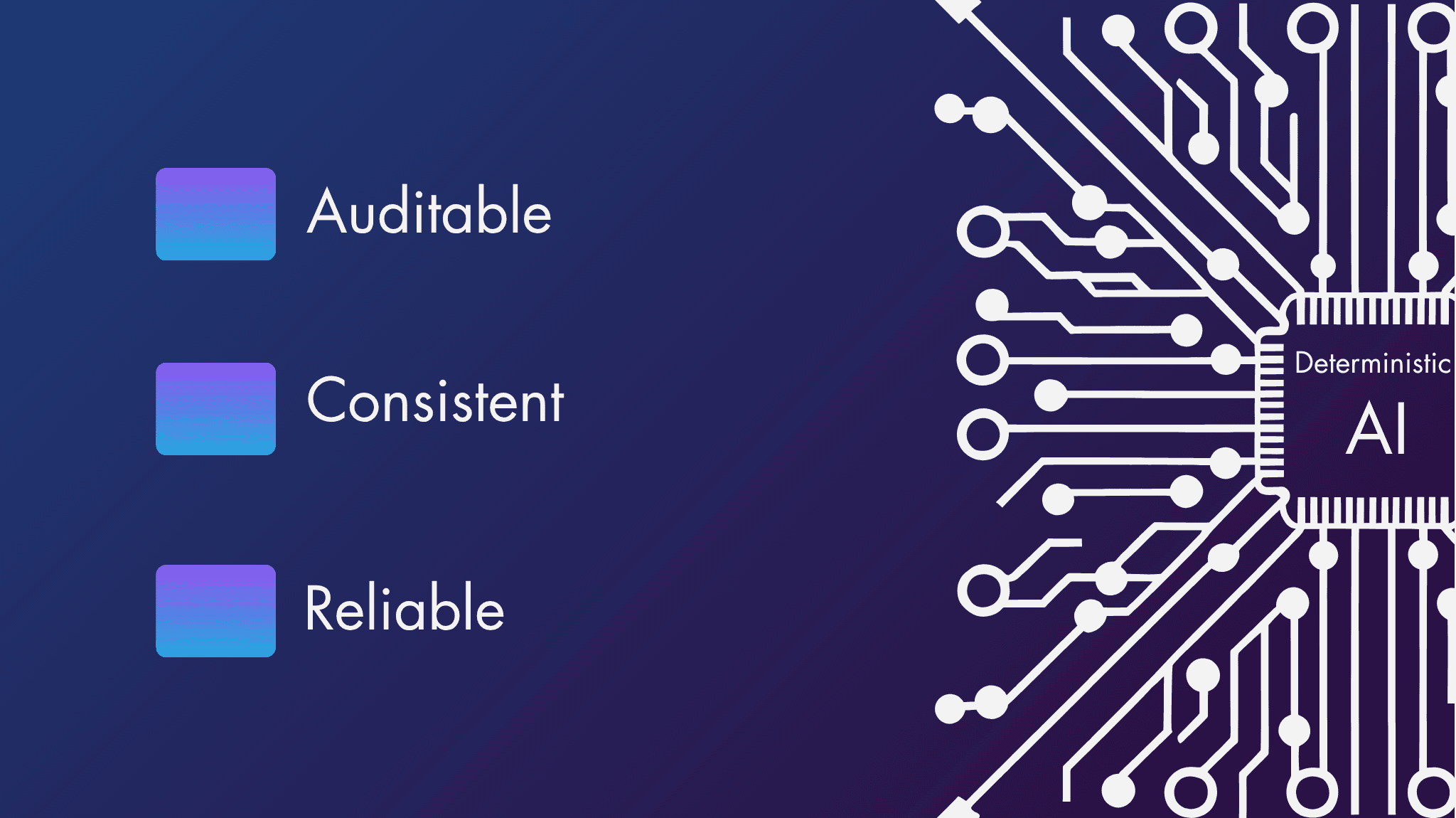
Table of Contents
If you’ve spent any time evaluating AI tools for analytics, you already know the feeling: you ask the same question twice, get two different answers, and spend the next hour trying to figure out which one to trust — or whether to trust either.
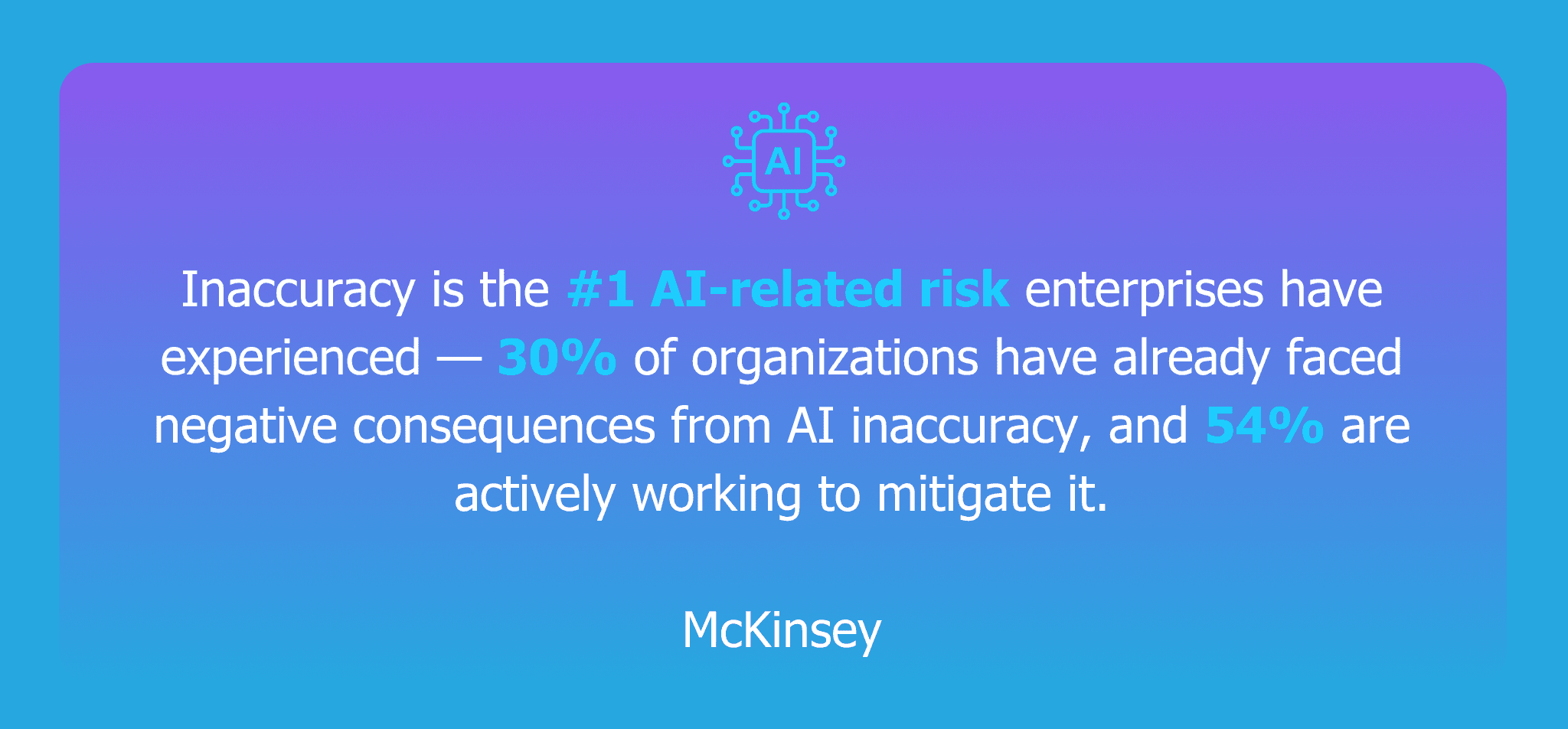
AI in analytics is everywhere right now. Every vendor is rushing to bolt a chat interface onto their product and call it intelligent. However, flashy demos and impressive-sounding features don’t mean much when your finance team is making budget decisions or your ops leads are planning around numbers that turn out to be wrong. In fact, 47% of enterprises have made decisions based on hallucinated AI outputs — and most didn't know it until the damage was done.
The real problem isn’t that AI exists in analytics. The problem is that most of it wasn’t built for decisions. It was built for exploration. When you’re running an enterprise, exploration without reliability is just expensive guesswork.
So how do you actually cut through the noise and choose the right AI for analytics? That starts with understanding what kind of AI you’re actually dealing with.
What Is a Deterministic AI Platform?
A deterministic AI platform is one where the same input always produces the same output. Ask the same question today, tomorrow, and six months from now — you get the same answer.
Most generative AI tools are probabilistic by design: they sample from a distribution of possible responses, which means answers shift, drift, and occasionally hallucinate facts with complete confidence. That’s fine for creative writing. It’s a serious liability for analytics.
A deterministic AI platform is built specifically for decisions, not exploration. It works with your structured, governed data. It applies consistent business logic. It doesn’t improvise. And critically, it can tell you how it arrived at an answer — not just what the answer is.
Key Criteria: How to Choose the Right AI for Analytics
Once you know what deterministic AI is, the next question is what to actually look for when evaluating a platform. Here’s what matters.
1. Accuracy and Consistency
This is the foundation. If an AI tool gives different answers to the same question depending on when you ask it — or who asks it — it cannot be trusted for business decisions. Full stop.
The bar should be simple: same question, same answer. Every time. Not “usually.” Not “approximately.” Every time.
Look for platforms that can demonstrate this with your own data, in your own environment, before you commit. Any vendor that can’t show you reproducible results on a representative set of queries is telling you something important about how their system works.
Accuracy in deterministic AI isn’t just a technical property — it’s the entire value proposition. Without it, you’re not actually getting analytics, you’re getting suggestions.
2. Data Governance
The accuracy of an AI platform is only as good as the data it’s working with. That means you need to understand: where does this platform get its answers from?
Platforms that pull from unstructured sources, blend internal and external data without clear provenance, or let the model “fill in gaps” using its training knowledge are introducing risk at every query. Business logic that lives in someone’s head — or in a model weight — isn’t governance. It’s a liability.
The right platform works with your trusted, structured data. It respects your definitions. When your finance team asks about revenue, it uses the same revenue definition that your CFO signed off on — not an approximation the model inferred from context.
3. Transparency
One of the most common failure modes in enterprise AI isn’t an obviously wrong answer — it’s an answer that seems right but can’t be verified. When a user can’t trace how a result was generated, they’re left with a choice between blind trust and time-consuming manual validation. Neither scales.
Transparency means being able to see the logic behind an answer. What data was queried? What filters were applied? What business rules were invoked? A platform that can show its work isn’t just more trustworthy — it’s faster to validate, easier to debug, and far more useful to the people relying on it.
This is one of the clearest differences between deterministic AI and generative approaches: generative models produce outputs that are often impossible to fully audit. Deterministic systems produce outputs that can be traced step by step.
4. Ease of Use for Business Users
Analytics AI that requires a technical intermediary isn’t self-serve — it’s just a fancier way to log a ticket. The whole point of natural language analytics is that business users can ask questions and get answers without waiting on an analyst or writing SQL.
Evaluate this criteria honestly. Can a finance manager ask a nuanced question and get a reliable, useful answer without help? Can someone in ops pull a custom report without knowing how the data is structured? If the answer is “yes, but only with training”, that’s a red flag.
The best platforms are built so that the AI handles the complexity, not the user.
5. Auditability
For teams in regulated industries — financial services, insurance, any public company managing compliance obligations — auditability is a requirement.
Auditability means having a complete, reliable record of what was asked, what data was accessed, and how answers were generated. It means being able to demonstrate to an auditor, a regulator, or an internal compliance team that your analytics environment is operating within defined guardrails.
Standard guardrails often fail in data analytics precisely because they were designed for general-purpose AI — not for the specific, structured demands of enterprise reporting. Platforms built for analytics should have auditability designed in from the ground up, not bolted on after the fact.
6. Integration with Your Existing Stack
The best analytics AI in the world doesn’t help you if it can’t connect to where your data actually lives. Before evaluating capabilities, evaluate compatibility.
Can it connect to your data warehouse — Snowflake, BigQuery, Redshift, Databricks? Does it work with the BI tools your teams already use? Can it sit alongside existing reporting infrastructure without requiring a full migration or a multi-year implementation?
The platforms worth considering are ones that extend what you have, not ones that ask you to replace it.

Red Flags to Watch Out For When Choosing AI Tool
Knowing what to look for is only half the job. You also need to recognize when something is wrong. Here are the warning signs that an AI analytics platform isn’t ready for enterprise use:
Different answers to the same query. If you ask the same question twice and get different numbers, stop the evaluation. This isn’t a minor inconsistency — it’s a fundamental architectural problem.
Requires constant validation. If every AI-generated answer has to be manually checked by an analyst before anyone will act on it, you haven’t reduced the analytics burden. You’ve added a new step.
Can’t explain its outputs. If a platform can’t show you the logic behind its answers, it can’t be trusted at scale.
Heavy reliance on analysts to make it work. A platform that requires ongoing analyst involvement to translate business questions into queries, or to QA outputs, isn’t delivering self-serve analytics. It’s delivering a more expensive version of what you already have.
If you’re seeing these patterns, it may be time to read 5 signs your enterprise analytics needs a deterministic AI platform — the symptoms are specific, and they’re worth recognizing early.
When Deterministic AI Is the Right Choice
Not every use case demands deterministic AI. If your team is exploring data, generating hypotheses, or building rough models for internal discussion, probabilistic tools can add genuine value. The flexibility is useful when precision isn’t the point.
But when the output is going to drive a real decision — when someone is going to use a number to set a budget, approve a headcount, adjust a forecast, or report to a board — you need to know that number is right. Every time.
Deterministic AI is the right choice when:
The stakes are high. Finance, operations, compliance, and executive reporting all require numbers that can be defended, not just estimated.
Trust is non-negotiable. When business users need to act without a validation step, the platform itself has to be trustworthy by design.
Self-serve analytics is the actual goal. Not “analysts can answer questions faster” but “business users can answer their own questions reliably, without help.”
If those conditions describe your environment, the question isn’t whether to consider deterministic AI. It’s which platform to choose.
Final Thoughts
Choosing AI for analytics isn’t really a question about technology. It’s a question about what you’re willing to trust — and what happens when that trust turns out to be misplaced.
Probabilistic AI tools are powerful, and in the right contexts, genuinely useful. But they were built for a different kind of problem. When accuracy is the whole point, when consistency is a requirement rather than a preference, and when real decisions depend on the output — that’s where deterministic AI earns its place.
The organizations that will get the most out of AI in analytics are the ones that are clear-eyed about this distinction early. They’re not chasing the most impressive demo. They’re asking the right question: can I trust this answer?
Deterministic AI is built to make that question easy to answer.
Ready to see how it works in practice? See how deterministic AI works →
Topics
Help teams explore data without compromising privacy.
Deterministic AI Platform: How to Choose the Right AI for Analytics
Published
8 min read
Topics:
Reliable AI
Table of Contents
If you’ve spent any time evaluating AI tools for analytics, you already know the feeling: you ask the same question twice, get two different answers, and spend the next hour trying to figure out which one to trust — or whether to trust either.
AI in analytics is everywhere right now. Every vendor is rushing to bolt a chat interface onto their product and call it intelligent. However, flashy demos and impressive-sounding features don’t mean much when your finance team is making budget decisions or your ops leads are planning around numbers that turn out to be wrong. In fact, 47% of enterprises have made decisions based on hallucinated AI outputs — and most didn't know it until the damage was done.
The real problem isn’t that AI exists in analytics. The problem is that most of it wasn’t built for decisions. It was built for exploration. When you’re running an enterprise, exploration without reliability is just expensive guesswork.
So how do you actually cut through the noise and choose the right AI for analytics? That starts with understanding what kind of AI you’re actually dealing with.
What Is a Deterministic AI Platform?
A deterministic AI platform is one where the same input always produces the same output. Ask the same question today, tomorrow, and six months from now — you get the same answer.
Most generative AI tools are probabilistic by design: they sample from a distribution of possible responses, which means answers shift, drift, and occasionally hallucinate facts with complete confidence. That’s fine for creative writing. It’s a serious liability for analytics.
A deterministic AI platform is built specifically for decisions, not exploration. It works with your structured, governed data. It applies consistent business logic. It doesn’t improvise. And critically, it can tell you how it arrived at an answer — not just what the answer is.
Key Criteria: How to Choose the Right AI for Analytics
Once you know what deterministic AI is, the next question is what to actually look for when evaluating a platform. Here’s what matters.
1. Accuracy and Consistency
This is the foundation. If an AI tool gives different answers to the same question depending on when you ask it — or who asks it — it cannot be trusted for business decisions. Full stop.
The bar should be simple: same question, same answer. Every time. Not “usually.” Not “approximately.” Every time.
Look for platforms that can demonstrate this with your own data, in your own environment, before you commit. Any vendor that can’t show you reproducible results on a representative set of queries is telling you something important about how their system works.
Accuracy in deterministic AI isn’t just a technical property — it’s the entire value proposition. Without it, you’re not actually getting analytics, you’re getting suggestions.
2. Data Governance
The accuracy of an AI platform is only as good as the data it’s working with. That means you need to understand: where does this platform get its answers from?
Platforms that pull from unstructured sources, blend internal and external data without clear provenance, or let the model “fill in gaps” using its training knowledge are introducing risk at every query. Business logic that lives in someone’s head — or in a model weight — isn’t governance. It’s a liability.
The right platform works with your trusted, structured data. It respects your definitions. When your finance team asks about revenue, it uses the same revenue definition that your CFO signed off on — not an approximation the model inferred from context.
3. Transparency
One of the most common failure modes in enterprise AI isn’t an obviously wrong answer — it’s an answer that seems right but can’t be verified. When a user can’t trace how a result was generated, they’re left with a choice between blind trust and time-consuming manual validation. Neither scales.
Transparency means being able to see the logic behind an answer. What data was queried? What filters were applied? What business rules were invoked? A platform that can show its work isn’t just more trustworthy — it’s faster to validate, easier to debug, and far more useful to the people relying on it.
This is one of the clearest differences between deterministic AI and generative approaches: generative models produce outputs that are often impossible to fully audit. Deterministic systems produce outputs that can be traced step by step.
4. Ease of Use for Business Users
Analytics AI that requires a technical intermediary isn’t self-serve — it’s just a fancier way to log a ticket. The whole point of natural language analytics is that business users can ask questions and get answers without waiting on an analyst or writing SQL.
Evaluate this criteria honestly. Can a finance manager ask a nuanced question and get a reliable, useful answer without help? Can someone in ops pull a custom report without knowing how the data is structured? If the answer is “yes, but only with training”, that’s a red flag.
The best platforms are built so that the AI handles the complexity, not the user.
5. Auditability
For teams in regulated industries — financial services, insurance, any public company managing compliance obligations — auditability is a requirement.
Auditability means having a complete, reliable record of what was asked, what data was accessed, and how answers were generated. It means being able to demonstrate to an auditor, a regulator, or an internal compliance team that your analytics environment is operating within defined guardrails.
Standard guardrails often fail in data analytics precisely because they were designed for general-purpose AI — not for the specific, structured demands of enterprise reporting. Platforms built for analytics should have auditability designed in from the ground up, not bolted on after the fact.
6. Integration with Your Existing Stack
The best analytics AI in the world doesn’t help you if it can’t connect to where your data actually lives. Before evaluating capabilities, evaluate compatibility.
Can it connect to your data warehouse — Snowflake, BigQuery, Redshift, Databricks? Does it work with the BI tools your teams already use? Can it sit alongside existing reporting infrastructure without requiring a full migration or a multi-year implementation?
The platforms worth considering are ones that extend what you have, not ones that ask you to replace it.
Red Flags to Watch Out For When Choosing AI Tool
Knowing what to look for is only half the job. You also need to recognize when something is wrong. Here are the warning signs that an AI analytics platform isn’t ready for enterprise use:
Different answers to the same query. If you ask the same question twice and get different numbers, stop the evaluation. This isn’t a minor inconsistency — it’s a fundamental architectural problem.
Requires constant validation. If every AI-generated answer has to be manually checked by an analyst before anyone will act on it, you haven’t reduced the analytics burden. You’ve added a new step.
Can’t explain its outputs. If a platform can’t show you the logic behind its answers, it can’t be trusted at scale.
Heavy reliance on analysts to make it work. A platform that requires ongoing analyst involvement to translate business questions into queries, or to QA outputs, isn’t delivering self-serve analytics. It’s delivering a more expensive version of what you already have.
If you’re seeing these patterns, it may be time to read 5 signs your enterprise analytics needs a deterministic AI platform — the symptoms are specific, and they’re worth recognizing early.
When Deterministic AI Is the Right Choice
Not every use case demands deterministic AI. If your team is exploring data, generating hypotheses, or building rough models for internal discussion, probabilistic tools can add genuine value. The flexibility is useful when precision isn’t the point.
But when the output is going to drive a real decision — when someone is going to use a number to set a budget, approve a headcount, adjust a forecast, or report to a board — you need to know that number is right. Every time.
Deterministic AI is the right choice when:
The stakes are high. Finance, operations, compliance, and executive reporting all require numbers that can be defended, not just estimated.
Trust is non-negotiable. When business users need to act without a validation step, the platform itself has to be trustworthy by design.
Self-serve analytics is the actual goal. Not “analysts can answer questions faster” but “business users can answer their own questions reliably, without help.”
If those conditions describe your environment, the question isn’t whether to consider deterministic AI. It’s which platform to choose.
Final Thoughts
Choosing AI for analytics isn’t really a question about technology. It’s a question about what you’re willing to trust — and what happens when that trust turns out to be misplaced.
Probabilistic AI tools are powerful, and in the right contexts, genuinely useful. But they were built for a different kind of problem. When accuracy is the whole point, when consistency is a requirement rather than a preference, and when real decisions depend on the output — that’s where deterministic AI earns its place.
The organizations that will get the most out of AI in analytics are the ones that are clear-eyed about this distinction early. They’re not chasing the most impressive demo. They’re asking the right question: can I trust this answer?
Deterministic AI is built to make that question easy to answer.
Ready to see how it works in practice? See how deterministic AI works →
More Updates