Topics

Help teams explore data without compromising privacy.
Help teams explore data without compromising privacy.
Scale Self-Service Analytics Without Compromising Data Governance
Published
5 min read
Topics:
Self-Service Analytics

Table of Contents
Self-service analytics exists to remove analyst and IT bottlenecks. Business users ask questions in plain language and get answers, without waiting on a data team to write a query. Most platforms deliver that speed by widening data access, but that access can come at a cost: conflicting metrics, security gaps, and data teams spending more time defending numbers than analyzing them.
Data governance is the fix, but for most organizations, governance means work. Certified datasets, semantic layers, field-level access control, sandbox-to-certified workflows: it's a legitimate framework, and it's also a standing engineering and analyst commitment that most teams don't have the headcount to run indefinitely.
How to Enable Self-Service Analytics Without Creating New Data Security Risks?
That's one of the first questions a data architect or security lead asks when evaluating any analytics tool. The concern is real: most platforms ingest data into their own environment to process it, which means your production data now lives in a second location you don't fully control. That creates replication risk, data residency headaches, and a whole new attack surface to defend. When looking for a self-service analytics solution, look for one that doesn’t require you to create a copy of your database. Chata.ai’s approach is: your data never leaves your database. Chata.ai learns its structure only, table names, columns, relationships, and executes SQL directly against the live source, in read-only mode. There's no bulk data transfer and no shadow copy sitting in a separate environment. The generated SQL runs against your database directly, using the access controls you already have in place.
How Do You Keep Definitions Consistent Across Self-Service Analytics?
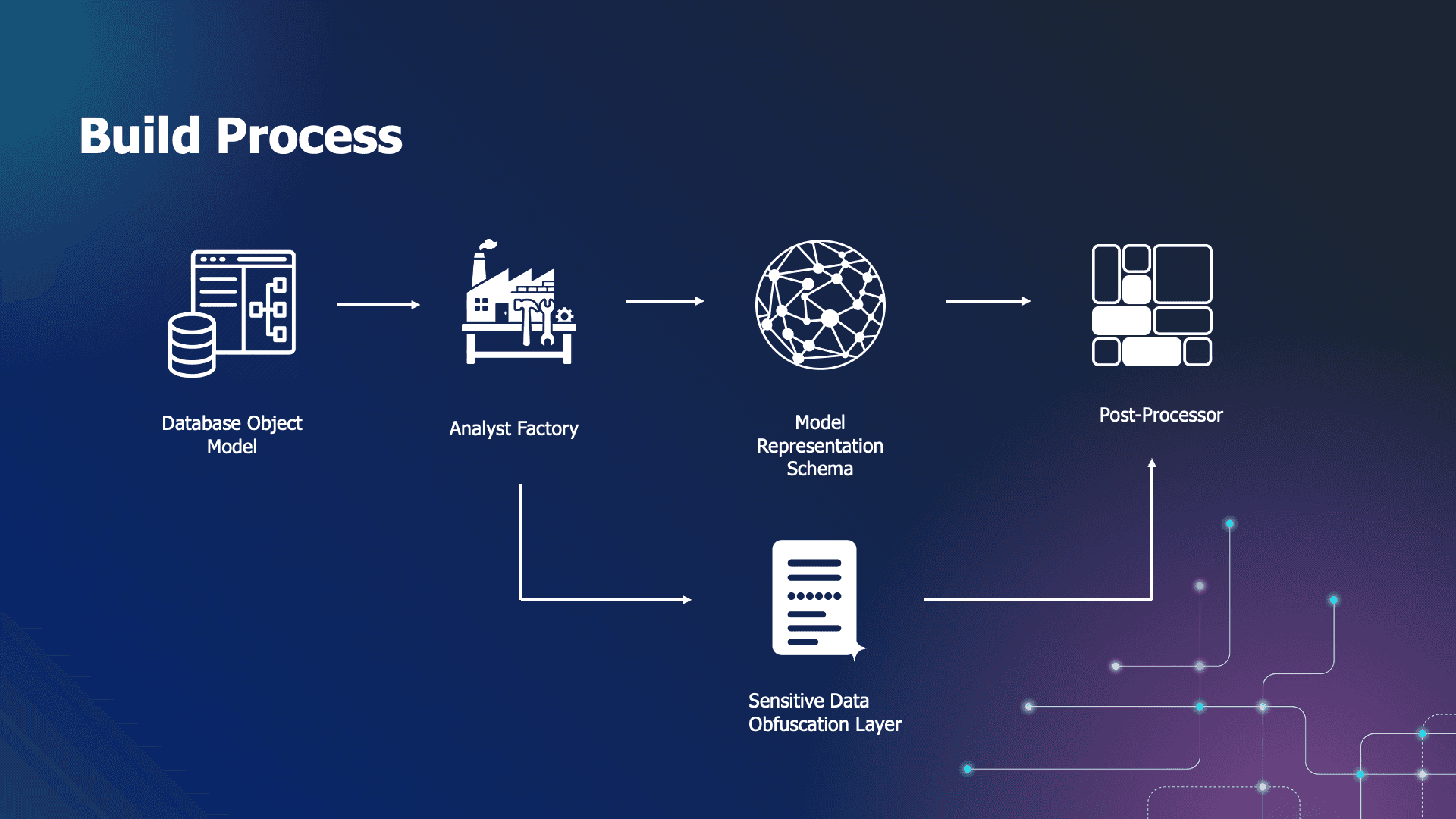
Ask five different teams what “revenue” means and you'll get five different numbers. Without a single source of truth for business terms, self-service analytics creates as much confusion as it resolves: dashboards disagree, definitions drift, and every new hire has to be told which numbers to actually trust. This is where the value of a schema comes into play, but building and maintaining that schema can also be a heavy lift for teams. This is why Chata.ai does the creation for you and combines the database object model with the business logic layer to create a Model Representation Schema, giving every business term a single, consistent definition across the organization. Chata.ai unifies the schema and logic from the start, eliminating the drift that comes from each team building and maintaining its own semantic layer. “Revenue” means the same thing whether the question comes from finance, sales, or the executive team, and it stays that way without manual upkeep.
Building that layer never requires exposing customer data. The schema is built from your database's structure, not its contents, a distinction Info-Tech Research Group's Advisory Fellow Igor Ikonnikov called out directly: “Customer data never enters the training process. The model is built from the schema, not the underlying data.”
How to Prevent Sensitive Data Exposure?
Sending customer data to a large language model raises an obvious question: what exactly does the model see? For any organization handling PII, financial records, or health information, that answer determines whether an AI analytics tool is usable at all, no matter how good its insights are. This is why finding a tool to de-identify sensitive data is important. With Chata.ai, before any query touches a language model, our Obfuscation Service masks sensitive data. A question like “What were the total transaction fees charged to John Doe at Canadian Capital last quarter?” becomes “What were the total transaction fees charged to ‹Cardholder› at ‹Institution› last quarter?” before it ever reaches the model. The LLM sees the user's obfuscated question and a set of instructions, a condensed version of the database structure and schema, simplified so the LLM understands the context. It never sees row-level content. That distinction matters for any organization operating under data residency or privacy requirements.
Can You Trust AI-generated SQL Queries for Regulated Business Decisions?
Generative AI has a consistency problem: ask the same question twice and you might get two different answers. For regulated industries, that unpredictability isn't just an accuracy issue, it's a compliance risk. A query that can't be reproduced and defended the same way twice can't be trusted for a decision that gets audited. This is why a deterministic query engine, one that produces the same SQL from the same question every time, matters for regulated decisions.
Chata.ai's proprietary Post-Processor translates Proto Query Logic Representation (PQLR) into SQL dynamically. That means that you always get the same answer, no matter how many times you ask the same question, and it’s validated before execution and fully reproducible. That determinism does double duty: it's an accuracy guarantee, and it's a governance guarantee, since quality control and audit teams are reviewing one known, repeatable process instead of chasing down inconsistent output.
Is It Possible to Audit an AI Analytics System?
Auditors and compliance teams don't take “trust the AI” as an answer. If every query, access event, and model interaction can't be reconstructed after the fact, the tool doesn't meet the bar for a regulated environment, regardless of how accurate its answers are. This is why organizations need to make sure they can verify every answer from an AI system. Every question run through Chata.ai is traceable: the natural language query the user typed, the SQL that was generated from it, and exactly what was sent to the LLM. Nothing in the pipeline happens out of view. In addition, row-level and column-level security enforce every permission before a query executes, and access runs through your existing identity provider (IdP), whether that's SAML, OAuth, or OpenID Connect (OIDC), so there's no duplicate permission system to maintain and no gap between what your IdP allows and what Chata.ai enforces.
Can AI Analytics Be Used in Highly Regulated or Privacy-Critical Industries?
Financial services, healthcare, and infrastructure sectors don't just want good governance — they require it contractually. The architecture has to hold up under institutional scrutiny, not just a standard enterprise procurement checklist. One of Chata.ai's customers, Sync Insights, is an analytics platform for Canton Network, a privacy-enabled open blockchain network. The Canton network was built from the ground up for institutional-grade privacy. Sub-transaction level privacy means each party only receives and records the parts of a transaction that apply to them, instead of replicating the full ledger across every node. Proof-of-Stakeholder consensus means only the parties involved in a transaction validate it. Canton is trusted by institutions including JPMorgan, BNP Paribas, and Broadridge on the strength of that architecture. It's the kind of environment where governance can't be an afterthought, and it's exactly where Chata.ai's architecture is built to operate. Chata.ai holds ISO 27001 certification and maintains SOC 2 Type II attestation, built to scale across thousands of users and tenants without compromising isolation.
What This Data Governance Architecture Delivers
Put together, these five layers mean data governance isn't something a customer configures around Chata.ai. It's the only way the system operates:
No bulk data replication and no write access, ever
One consistent semantic definition of every business term, with nothing to build or reconcile
Sensitive data masked before an LLM ever sees it
Deterministic, auditable SQL generation
Full audit trails and permissions inherited directly from your identity provider
Chata.ai holds ISO 27001 certification and SOC 2 Type II attestation
Self-service analytics shouldn't force a choice between speed and control. With governance built into the architecture instead of bolted on around it, it doesn't have to.
See how Chata.ai's security architecture works with your data. Book a Walkthrough.
Topics
Help teams explore data without compromising privacy.
Scale Self-Service Analytics Without Compromising Data Governance
Published
5 min read
Topics:
Self-Service Analytics
Table of Contents
Self-service analytics exists to remove analyst and IT bottlenecks. Business users ask questions in plain language and get answers, without waiting on a data team to write a query. Most platforms deliver that speed by widening data access, but that access can come at a cost: conflicting metrics, security gaps, and data teams spending more time defending numbers than analyzing them.
Data governance is the fix, but for most organizations, governance means work. Certified datasets, semantic layers, field-level access control, sandbox-to-certified workflows: it's a legitimate framework, and it's also a standing engineering and analyst commitment that most teams don't have the headcount to run indefinitely.
How to Enable Self-Service Analytics Without Creating New Data Security Risks?
That's one of the first questions a data architect or security lead asks when evaluating any analytics tool. The concern is real: most platforms ingest data into their own environment to process it, which means your production data now lives in a second location you don't fully control. That creates replication risk, data residency headaches, and a whole new attack surface to defend. When looking for a self-service analytics solution, look for one that doesn’t require you to create a copy of your database. Chata.ai’s approach is: your data never leaves your database. Chata.ai learns its structure only, table names, columns, relationships, and executes SQL directly against the live source, in read-only mode. There's no bulk data transfer and no shadow copy sitting in a separate environment. The generated SQL runs against your database directly, using the access controls you already have in place.
How Do You Keep Definitions Consistent Across Self-Service Analytics?
Ask five different teams what “revenue” means and you'll get five different numbers. Without a single source of truth for business terms, self-service analytics creates as much confusion as it resolves: dashboards disagree, definitions drift, and every new hire has to be told which numbers to actually trust. This is where the value of a schema comes into play, but building and maintaining that schema can also be a heavy lift for teams. This is why Chata.ai does the creation for you and combines the database object model with the business logic layer to create a Model Representation Schema, giving every business term a single, consistent definition across the organization. Chata.ai unifies the schema and logic from the start, eliminating the drift that comes from each team building and maintaining its own semantic layer. “Revenue” means the same thing whether the question comes from finance, sales, or the executive team, and it stays that way without manual upkeep.
Building that layer never requires exposing customer data. The schema is built from your database's structure, not its contents, a distinction Info-Tech Research Group's Advisory Fellow Igor Ikonnikov called out directly: “Customer data never enters the training process. The model is built from the schema, not the underlying data.”
How to Prevent Sensitive Data Exposure?
Sending customer data to a large language model raises an obvious question: what exactly does the model see? For any organization handling PII, financial records, or health information, that answer determines whether an AI analytics tool is usable at all, no matter how good its insights are. This is why finding a tool to de-identify sensitive data is important. With Chata.ai, before any query touches a language model, our Obfuscation Service masks sensitive data. A question like “What were the total transaction fees charged to John Doe at Canadian Capital last quarter?” becomes “What were the total transaction fees charged to ‹Cardholder› at ‹Institution› last quarter?” before it ever reaches the model. The LLM sees the user's obfuscated question and a set of instructions, a condensed version of the database structure and schema, simplified so the LLM understands the context. It never sees row-level content. That distinction matters for any organization operating under data residency or privacy requirements.
Can You Trust AI-generated SQL Queries for Regulated Business Decisions?
Generative AI has a consistency problem: ask the same question twice and you might get two different answers. For regulated industries, that unpredictability isn't just an accuracy issue, it's a compliance risk. A query that can't be reproduced and defended the same way twice can't be trusted for a decision that gets audited. This is why a deterministic query engine, one that produces the same SQL from the same question every time, matters for regulated decisions.
Chata.ai's proprietary Post-Processor translates Proto Query Logic Representation (PQLR) into SQL dynamically. That means that you always get the same answer, no matter how many times you ask the same question, and it’s validated before execution and fully reproducible. That determinism does double duty: it's an accuracy guarantee, and it's a governance guarantee, since quality control and audit teams are reviewing one known, repeatable process instead of chasing down inconsistent output.
Is It Possible to Audit an AI Analytics System?
Auditors and compliance teams don't take “trust the AI” as an answer. If every query, access event, and model interaction can't be reconstructed after the fact, the tool doesn't meet the bar for a regulated environment, regardless of how accurate its answers are. This is why organizations need to make sure they can verify every answer from an AI system. Every question run through Chata.ai is traceable: the natural language query the user typed, the SQL that was generated from it, and exactly what was sent to the LLM. Nothing in the pipeline happens out of view. In addition, row-level and column-level security enforce every permission before a query executes, and access runs through your existing identity provider (IdP), whether that's SAML, OAuth, or OpenID Connect (OIDC), so there's no duplicate permission system to maintain and no gap between what your IdP allows and what Chata.ai enforces.
Can AI Analytics Be Used in Highly Regulated or Privacy-Critical Industries?
Financial services, healthcare, and infrastructure sectors don't just want good governance — they require it contractually. The architecture has to hold up under institutional scrutiny, not just a standard enterprise procurement checklist. One of Chata.ai's customers, Sync Insights, is an analytics platform for Canton Network, a privacy-enabled open blockchain network. The Canton network was built from the ground up for institutional-grade privacy. Sub-transaction level privacy means each party only receives and records the parts of a transaction that apply to them, instead of replicating the full ledger across every node. Proof-of-Stakeholder consensus means only the parties involved in a transaction validate it. Canton is trusted by institutions including JPMorgan, BNP Paribas, and Broadridge on the strength of that architecture. It's the kind of environment where governance can't be an afterthought, and it's exactly where Chata.ai's architecture is built to operate. Chata.ai holds ISO 27001 certification and maintains SOC 2 Type II attestation, built to scale across thousands of users and tenants without compromising isolation.
What This Data Governance Architecture Delivers
Put together, these five layers mean data governance isn't something a customer configures around Chata.ai. It's the only way the system operates:
No bulk data replication and no write access, ever
One consistent semantic definition of every business term, with nothing to build or reconcile
Sensitive data masked before an LLM ever sees it
Deterministic, auditable SQL generation
Full audit trails and permissions inherited directly from your identity provider
Chata.ai holds ISO 27001 certification and SOC 2 Type II attestation
Self-service analytics shouldn't force a choice between speed and control. With governance built into the architecture instead of bolted on around it, it doesn't have to.
See how Chata.ai's security architecture works with your data. Book a Walkthrough.
More Updates