Topics

Help teams explore data without compromising privacy.
Help teams explore data without compromising privacy.
Gaming Analytics for Compliance: Catch CTR Aggregation and Structuring Across Systems

Published
5 min read
Topics:
Gaming Analytics

Table of Contents
Your Anti-Money Laundering (AML) platform flags what it sees. Your casino management system (CMS) logs what happens. Compliance is everything in between.
Nowhere is that gap wider than in Title 31 Currency Transaction Report. A patron's activity can be spread across the cage, slot handpays, TITO redemptions, and kiosks. Each system sees only its own slice, and none of them sees the total.
For most BSA officers, the fix is manual. Analysts export from each system after the gaming day closes, stitch the files together, and hope nothing was missed. Meanwhile the 15-day CTRC clock is already running.
This post walks through two use cases where gaming analytics for compliance changes that: CTR aggregation and structuring detection. Both depend on cross-system monitoring, meaning one view of patron activity across every source at once.
Why CTR Aggregation and Structuring Slip Through Single Systems
Each casino system does its own job well. The cage tracks cash in and out. The slot system logs handpays and bill-in. TITO tracks ticket redemptions. Your AML platform screens the data it is fed.
Regulators, however, don't care which system recorded a transaction. Title 31 requires you to aggregate a patron's cash activity across the full gaming day. If the total crosses $10,000, you file, regardless of how many stops it took to get there.
That creates two blind spots:
Missed aggregation: activity crosses the threshold in total but never in any single system, so no alert fires.
Hidden structuring: a patron deliberately keeps each transaction under $10,000, and the pattern only appears when you line up every department and every visit.
Gaming data analytics closes both by reading across sources together. Chata.ai connects to cage, slots, TITO, cashless, kiosk, and your AML system where they already live. It is CMS agnostic, with no data migration and no system replacement.
What Missed CTRs and SARs Have Cost Casinos
Federal and state enforcement actions from 2016 to 2025 show the same pattern. The evidence was usually already sitting in the casino's own logs and player data. Nobody connected it in time.
Indiana Gaming Commission. Failed to implement CTR and Multiple Transaction Log tracking when reopening their poker room. Seven transactions not properly logged. Small fine, but it shows regulators are watching for operational gaps even at smaller properties.
FinCEN. Filed zero SARs for three years. Dozens of structuring and chip-walking incidents sitting in their own transaction logs, unreported. No compliance officer until 2017. No AML training for any employee. Cash cage policy referenced a 2005 document stating SARs were “not mandatory.” First joint FinCEN and California DOJ enforcement action.
FinCEN. 80% of SARs filed had unknown subjects, despite having player card data that would have identified them. A patron connected to 15 prior SARs who repeatedly refused to provide ID was allowed to continue gambling. Employee caught helping customers structure transactions in 2009, disciplined, then did the same thing again in 2013.
Use case 1: CTR Aggregation Caught the Moment It Crosses
The problem. A patron cashes out chips at the cage, takes a slot handpay, and redeems TITO tickets in the same gaming day. No single transaction looks large. Combined, they cross $10,000. Title 31 says aggregate and file a CTRC within 15 days, but if nobody sees the total, nobody files.
The alert. Chata.ai flags it as a cross-source alert, during the gaming day rather than after it closes:
CTR Report due in 2 days. Patron activity across cage, slot, handpay, and TITO totals over $10K with no CTR report on file.
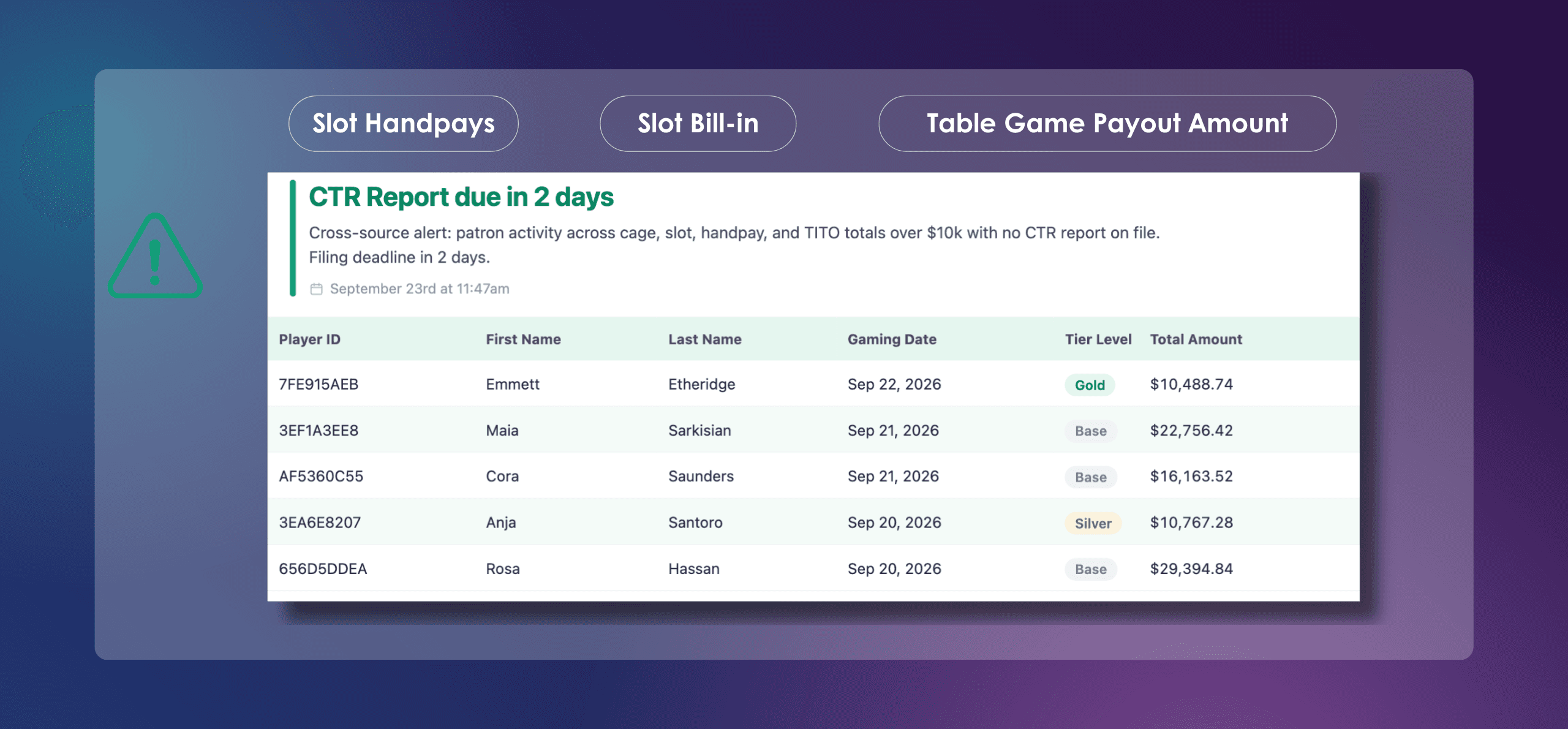
The alert comes as a report that lists each patron with their ID, name, tier level, gaming day, and aggregated total. In one example, five patrons crossed the threshold with totals ranging from $10,488 to $29,394. None of them had a CTRC on file.
The investigation. Your BSA officer follows up in plain English, without waiting on IT for a custom report:
"For each player, show the transactions that contributed to the amount."
"How was each transaction linked to this patron: player card, ID scan, surveillance, or inferred?"
"What was this patron's total cash activity by day for the last 30 days?"
The second question matters most. Linking a patron to a transaction by player card is very different from linking by surveillance or inference, and examiners will ask.
The outcome. The CTRC goes out on time, with a transaction-level breakdown behind it instead of a reconstructed spreadsheet. Deadline tracking keeps every open filing visible until it is closed.
Use case 2: Structuring That Doesn't Look Like Structuring
The problem. A guest knows the $10,000 line. They split activity across departments and visits to stay under it at every stop: $9,400 at the cage, a ticket redemption at the kiosk, another cash-out the next morning. Viewed through the cage window, nothing stands out. Viewed through the slot system, nothing stands out. Across the whole floor, the pattern is obvious.
The alert. Chata.ai flags the pattern across systems, even though no single transaction triggered a CTR:
Possible Structuring Detected. Patron made 3 cash transactions between $8,000 and $10,000 across cage and kiosk over 2 consecutive gaming days.

The alert shows the patron, each transaction's amount, location, and time, and how close each one came to the $10,000 line.
The investigation. Instead of building a one-off report, the compliance team digs in by asking:
"List all patrons with 2 or more cash transactions between $9,000 and $9,999 in the same gaming day or on consecutive gaming days."
"Which patrons cashed out at the same cage window within 30 minutes of these transactions?"
"Which cashier handled these transactions?"
"Chart [this patron's] cash activity by day of week."
Each answer comes back with the query that produced it, so your team can see exactly which tables and filters were used.
The outcome. Chata.ai surfaces the pattern automatically. Your team decides whether it warrants a SAR-C. The judgment call stays with the people accountable for it, and the supporting history is ready if you do file.
AI for Casinos That Passes an Audit
AI for casinos only works in compliance if the results survive an examiner's questions. Three design choices make that possible.
The query is the audit trail. Every result traces back to the SQL that ran and the tables it touched. When the examiner asks how you got the number, you show them. A request for six months of activity on a patron becomes a question instead of a project.
Nothing leaves your walls. Chata.ai runs inside your infrastructure or private cloud through a read-only credential. Sensitive fields such as player names and credit lines are masked. It is ISO 27001 certified, SOC 2 Type II attested, and runs on Azure, GCP, AWS, or on-prem.
A human approves every action. Every automated action stops for a person before it moves. You approve it, or it doesn't happen. BSA officers can be held personally liable, so the system shouldn't make the call for them. You set the thresholds and decide what gets flagged.

Beyond Title 31: What Else Cross-System Monitoring Covers
The same cross-source approach applies across the rest of the compliance program:
Variance and reconciliation: bill-in meter vs. soft count drop, hold variance against certified theoretical, and MICS/SICS documentation for state and tribal gaming exams.
Self-exclusion and responsible gaming: excluded patrons flagged across cage, slots, cashless, and kiosk before a payout, plus velocity and session-length triggers.
List matching: 314(a) list matching and OFAC screening support, plus MTL reconciliation.
Catch It While There's Still Time to File
Missed CTR aggregation and hidden structuring share one root cause: the evidence is split across systems that don't talk to each other. Cross-system compliance monitoring puts that evidence in one view, across shifts rather than at day's end. Your team spends its time working the pattern instead of hunting for it.
What would this look like for your casino? Book 20 minutes with Chata.ai. We'll learn your setup and show you what gaming analytics for compliance can surface in your own data. Book a demo →
Topics
Help teams explore data without compromising privacy.
Gaming Analytics for Compliance: Catch CTR Aggregation and Structuring Across Systems
Published
5 min read
Topics:
Gaming Analytics
Table of Contents
Your Anti-Money Laundering (AML) platform flags what it sees. Your casino management system (CMS) logs what happens. Compliance is everything in between.
Nowhere is that gap wider than in Title 31 Currency Transaction Report. A patron's activity can be spread across the cage, slot handpays, TITO redemptions, and kiosks. Each system sees only its own slice, and none of them sees the total.
For most BSA officers, the fix is manual. Analysts export from each system after the gaming day closes, stitch the files together, and hope nothing was missed. Meanwhile the 15-day CTRC clock is already running.
This post walks through two use cases where gaming analytics for compliance changes that: CTR aggregation and structuring detection. Both depend on cross-system monitoring, meaning one view of patron activity across every source at once.
Why CTR Aggregation and Structuring Slip Through Single Systems
Each casino system does its own job well. The cage tracks cash in and out. The slot system logs handpays and bill-in. TITO tracks ticket redemptions. Your AML platform screens the data it is fed.
Regulators, however, don't care which system recorded a transaction. Title 31 requires you to aggregate a patron's cash activity across the full gaming day. If the total crosses $10,000, you file, regardless of how many stops it took to get there.
That creates two blind spots:
Missed aggregation: activity crosses the threshold in total but never in any single system, so no alert fires.
Hidden structuring: a patron deliberately keeps each transaction under $10,000, and the pattern only appears when you line up every department and every visit.
Gaming data analytics closes both by reading across sources together. Chata.ai connects to cage, slots, TITO, cashless, kiosk, and your AML system where they already live. It is CMS agnostic, with no data migration and no system replacement.
What Missed CTRs and SARs Have Cost Casinos
Federal and state enforcement actions from 2016 to 2025 show the same pattern. The evidence was usually already sitting in the casino's own logs and player data. Nobody connected it in time.
Indiana Gaming Commission. Failed to implement CTR and Multiple Transaction Log tracking when reopening their poker room. Seven transactions not properly logged. Small fine, but it shows regulators are watching for operational gaps even at smaller properties.
FinCEN. Filed zero SARs for three years. Dozens of structuring and chip-walking incidents sitting in their own transaction logs, unreported. No compliance officer until 2017. No AML training for any employee. Cash cage policy referenced a 2005 document stating SARs were “not mandatory.” First joint FinCEN and California DOJ enforcement action.
FinCEN. 80% of SARs filed had unknown subjects, despite having player card data that would have identified them. A patron connected to 15 prior SARs who repeatedly refused to provide ID was allowed to continue gambling. Employee caught helping customers structure transactions in 2009, disciplined, then did the same thing again in 2013.
Use case 1: CTR Aggregation Caught the Moment It Crosses
The problem. A patron cashes out chips at the cage, takes a slot handpay, and redeems TITO tickets in the same gaming day. No single transaction looks large. Combined, they cross $10,000. Title 31 says aggregate and file a CTRC within 15 days, but if nobody sees the total, nobody files.
The alert. Chata.ai flags it as a cross-source alert, during the gaming day rather than after it closes:
CTR Report due in 2 days. Patron activity across cage, slot, handpay, and TITO totals over $10K with no CTR report on file.
The alert comes as a report that lists each patron with their ID, name, tier level, gaming day, and aggregated total. In one example, five patrons crossed the threshold with totals ranging from $10,488 to $29,394. None of them had a CTRC on file.
The investigation. Your BSA officer follows up in plain English, without waiting on IT for a custom report:
"For each player, show the transactions that contributed to the amount."
"How was each transaction linked to this patron: player card, ID scan, surveillance, or inferred?"
"What was this patron's total cash activity by day for the last 30 days?"
The second question matters most. Linking a patron to a transaction by player card is very different from linking by surveillance or inference, and examiners will ask.
The outcome. The CTRC goes out on time, with a transaction-level breakdown behind it instead of a reconstructed spreadsheet. Deadline tracking keeps every open filing visible until it is closed.
Use case 2: Structuring That Doesn't Look Like Structuring
The problem. A guest knows the $10,000 line. They split activity across departments and visits to stay under it at every stop: $9,400 at the cage, a ticket redemption at the kiosk, another cash-out the next morning. Viewed through the cage window, nothing stands out. Viewed through the slot system, nothing stands out. Across the whole floor, the pattern is obvious.
The alert. Chata.ai flags the pattern across systems, even though no single transaction triggered a CTR:
Possible Structuring Detected. Patron made 3 cash transactions between $8,000 and $10,000 across cage and kiosk over 2 consecutive gaming days.
The alert shows the patron, each transaction's amount, location, and time, and how close each one came to the $10,000 line.
The investigation. Instead of building a one-off report, the compliance team digs in by asking:
"List all patrons with 2 or more cash transactions between $9,000 and $9,999 in the same gaming day or on consecutive gaming days."
"Which patrons cashed out at the same cage window within 30 minutes of these transactions?"
"Which cashier handled these transactions?"
"Chart [this patron's] cash activity by day of week."
Each answer comes back with the query that produced it, so your team can see exactly which tables and filters were used.
The outcome. Chata.ai surfaces the pattern automatically. Your team decides whether it warrants a SAR-C. The judgment call stays with the people accountable for it, and the supporting history is ready if you do file.
AI for Casinos That Passes an Audit
AI for casinos only works in compliance if the results survive an examiner's questions. Three design choices make that possible.
The query is the audit trail. Every result traces back to the SQL that ran and the tables it touched. When the examiner asks how you got the number, you show them. A request for six months of activity on a patron becomes a question instead of a project.
Nothing leaves your walls. Chata.ai runs inside your infrastructure or private cloud through a read-only credential. Sensitive fields such as player names and credit lines are masked. It is ISO 27001 certified, SOC 2 Type II attested, and runs on Azure, GCP, AWS, or on-prem.
A human approves every action. Every automated action stops for a person before it moves. You approve it, or it doesn't happen. BSA officers can be held personally liable, so the system shouldn't make the call for them. You set the thresholds and decide what gets flagged.
Beyond Title 31: What Else Cross-System Monitoring Covers
The same cross-source approach applies across the rest of the compliance program:
Variance and reconciliation: bill-in meter vs. soft count drop, hold variance against certified theoretical, and MICS/SICS documentation for state and tribal gaming exams.
Self-exclusion and responsible gaming: excluded patrons flagged across cage, slots, cashless, and kiosk before a payout, plus velocity and session-length triggers.
List matching: 314(a) list matching and OFAC screening support, plus MTL reconciliation.
Catch It While There's Still Time to File
Missed CTR aggregation and hidden structuring share one root cause: the evidence is split across systems that don't talk to each other. Cross-system compliance monitoring puts that evidence in one view, across shifts rather than at day's end. Your team spends its time working the pattern instead of hunting for it.
What would this look like for your casino? Book 20 minutes with Chata.ai. We'll learn your setup and show you what gaming analytics for compliance can surface in your own data. Book a demo →
More Updates