Topics

Help teams explore data without compromising privacy.
Help teams explore data without compromising privacy.
How to Audit AI-Generated Reports for Accuracy?

Published
5 min read
Topics:
Reliable AI
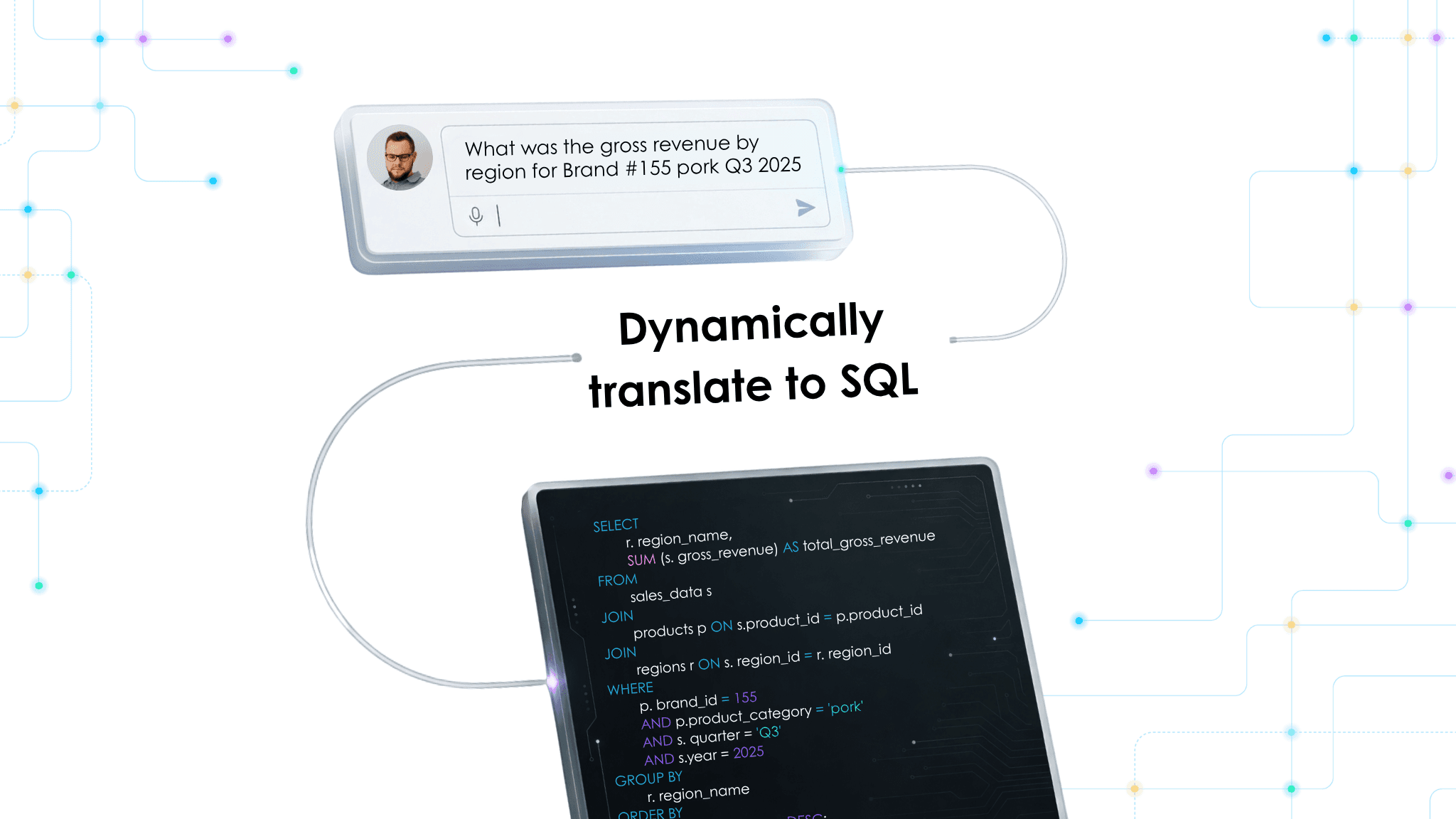
Table of Contents
Your finance manager asked the AI a straightforward question: revenue by region Q2 vs Q1. Thirty seconds later, a clean table appeared. The numbers looked reasonable. They screenshotted it for the leadership deck. Nobody asked where the numbers came from.
That's the moment this article is about. Not AI as a concept — but the specific, quiet risk that sits inside AI-generated data analytics, where a wrong aggregate or a misread date range looks identical to a correct one.
According to Deloitte's 2025 Global AI Survey, 47% of enterprise AI users made at least one major business decision based on hallucinated results in 2024. That's not a fringe problem. It's a majority-of-organisations problem, already playing out across finance, operations, and strategy teams.
The question is how to verify AI-generated reports — and which systems are actually built to be verified.
The Problem With Auditing AI-Generated Numbers
The issue isn't AI in analytics broadly — it's what happens when generative AI tools are used to answer data questions they weren't built to answer reliably.
Generative AI models — the technology behind tools like ChatGPT, Copilot, and most AI-assisted BI features — are designed to produce fluent, plausible responses. They predict the most statistically likely next token, not the most factually correct answer. When applied to business analytics, that distinction matters enormously. A model generating a revenue figure has no direct connection to your database. It's working from patterns in its training, retrieved documents, or a loosely structured prompt. It produces something that looks like a data result. It isn't one.
In practice, this means fabricated aggregations, wrong date ranges, and misattributed metrics that blend seamlessly into the output. Unlike a garbled sentence, a confident-looking number passes right through most quality checks — because those checks were built to catch human errors like formula mistakes or copy-paste slips, not outputs from a model that has no awareness of whether its answer is correct, only of whether it sounds plausible.
The broader confidence gap is well-documented: only 25% of US adults trust AI to provide accurate information, and trust in AI companies dropped from 61% to 53% globally in 2024 (Edelman Trust Barometer). Yet adoption keeps accelerating. The gap between using AI and trusting AI is where untracked errors accumulate.
Why Auditable AI Requires a Different Architecture
The platforms that are explainable and auditable share a structural characteristic: the AI generates a query, not an answer. The database produces the result.
Chata.ai's AutoQL works this way by design. When a user asks a business question in plain English, the platform translates it into an exact structured query against the organisation's own data, executes it, and returns a verified result — with the query surfaced alongside the output. Every answer is traceable back to its source. Every query is logged. The same question, asked tomorrow, returns the same answer from the same logic.
This is what Chata.ai describes as deterministic AI: no large language model in the query path, no probabilistic generation of numbers, no inference filling gaps where data is missing. The system runs on standard CPUs rather than the GPU infrastructure generative models require, which also means the cost profile scales differently — a meaningful consideration for organisations deploying analytics across hundreds or thousands of users.
The industries where this architecture has been adopted — financial services, banking, government, healthcare, railway operations — are ones where a wrong number carries regulatory weight. An audit trail is not a compliance checkbox in those sectors. It's a procurement requirement.

What This Looks Like in Practice
Let's take a real example. An operations manager asks: "What was the gross revenue by region for Brand #155 pork, Q2 2026 vs Q1?"
Within seconds, AutoQL returns a clean, structured table — East, MidWest, NorthWest, South, SouthWest, West — with Q1 figures, Q2 figures, and percentage change for each region. Below the result, AutoQL displays exactly how it interpreted the question: "Total Gross Profit by Region, Apr 1–Jun 30 2026 vs Jan 1–Mar 31 2026, Brand #155 pork (Product)." No ambiguity about what was calculated, which product was filtered, or which date ranges were applied.
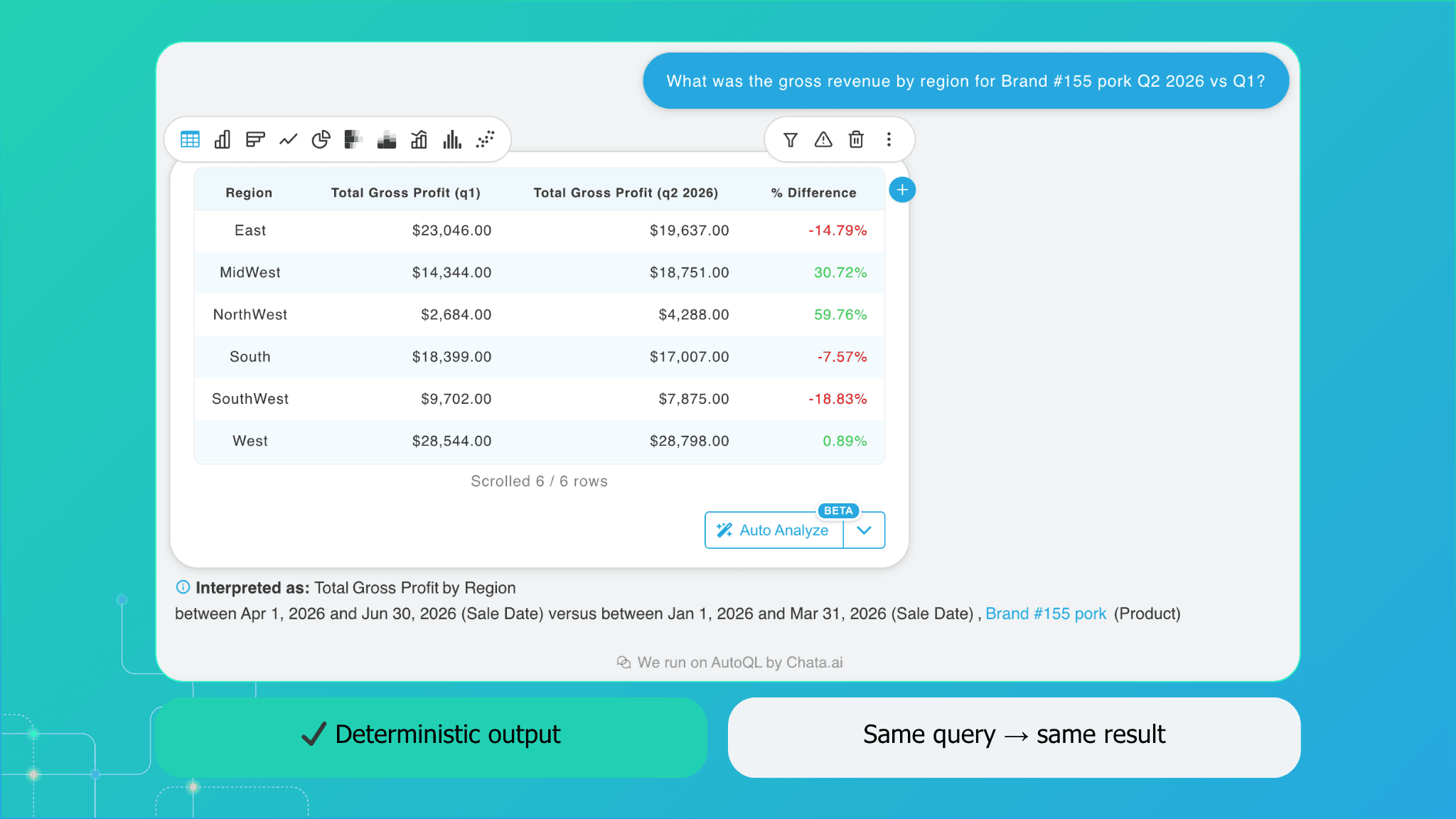
That's the output. Here's what's behind it.
In the AutoQL query log, the same question is recorded against a username, timestamp, data source, and project — and the full SQL query is surfaced alongside it. Every join, every filter, every date boundary, every aggregation is visible and inspectable. Anyone with access can open that log entry and see, line by line, exactly how that revenue figure was produced — and run it again to get the exact same result.
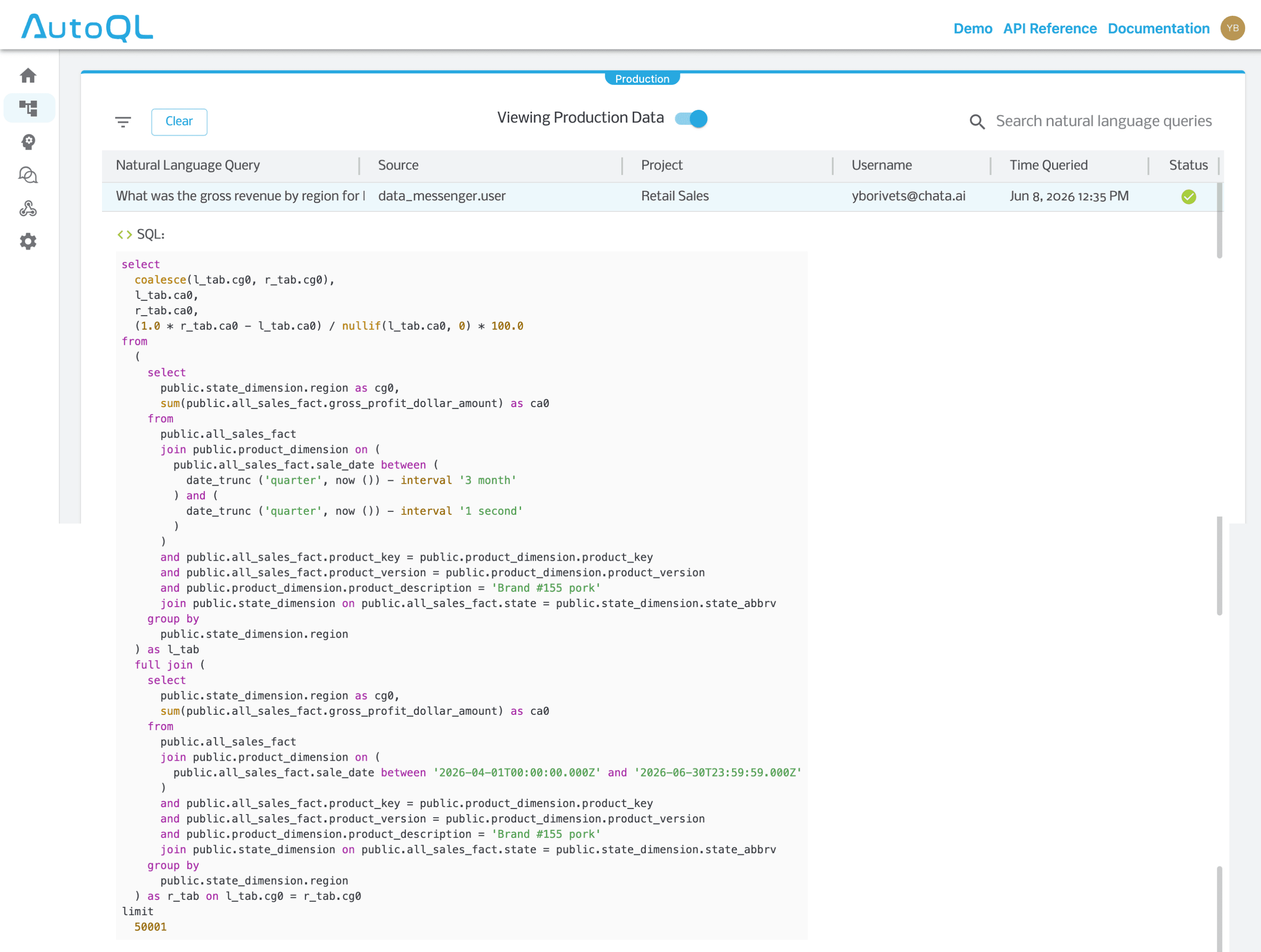
This is what step one of the audit framework means in practice: a number you can trace all the way back to the tables and logic that generated it. Not a result that looks right. A result you can prove is right.
How to Audit AI-Generated Reports
Each step applies to any AI-generated analytics output. The further down the list you can go with confidence, the more auditable your system actually is.
1. Trace every number to its source. For any figure in the report, you should be able to see the exact query or logic that produced it — which tables were read, which filters applied, which aggregations performed. If a number can't be traced, treat it as unverified. With AutoQL, every answer surfaces the precise structured query that produced it, visible to any business user without needing a technical team to interpret it.
2. Test for reproducibility. Ask the same question twice. If the underlying data hasn't changed, the answer should be identical. Variation between runs is a signal that the output is being generated probabilistically rather than retrieved. Chata.ai's deterministic model guarantees the same logic, the same result, every time — no variation.
3. Validate against governed source data. Verify the answer came from your trusted, structured data — not from model inference filling a gap. The data source should be the source of truth, with no generated values standing in for retrieved ones. AutoQL connects directly to your existing databases and queries data where it lives. Nothing is copied, inferred, or synthesised.
4. Confirm the audit trail exists by design. Logging bolted on after the fact can tell you an answer was produced; it can't always tell you how. A trustworthy system surfaces the underlying query as a natural byproduct of how it works. Chata.ai logs every query automatically — access is controlled, every result is traceable, and any output can be reproduced exactly as originally generated. For finance, compliance, and regulated operations, this isn't a feature to turn on. It's the default.
Quick Audit Checklist
- ☐ Every figure traces back to a visible query or logic
- ☐ Identical questions return identical answers
- ☐ Metric definitions match business rules
- ☐ Answers sourced from governed data, not inference
- ☐ Audit trail available on demand, by design
Want to see what auditable, deterministic AI analytics looks like in practice? Book a demo with Chata.ai or explore how AutoQL works.
FAQ
What is an AI audit trail in analytics? An AI audit trail is a complete, reproducible log of every query an AI system executed, the data sources it accessed, and the result it returned — so any output can be traced back to its source and reproduced on demand.
How do I know if an AI-generated report is accurate? Check these things: whether the system can show you the query that produced the output; whether the same question returns a consistent answer; and whether a full query log exists.
What does auditable AI mean? Auditable AI refers to systems where every output can be traced, reproduced, and verified — not through manual oversight layers, but through architecture that makes traceability the default rather than an added feature.
Topics
Help teams explore data without compromising privacy.
How to Audit AI-Generated Reports for Accuracy?
Published
5 min read
Topics:
Reliable AI
Table of Contents
Your finance manager asked the AI a straightforward question: revenue by region Q2 vs Q1. Thirty seconds later, a clean table appeared. The numbers looked reasonable. They screenshotted it for the leadership deck. Nobody asked where the numbers came from.
That's the moment this article is about. Not AI as a concept — but the specific, quiet risk that sits inside AI-generated data analytics, where a wrong aggregate or a misread date range looks identical to a correct one.
According to Deloitte's 2025 Global AI Survey, 47% of enterprise AI users made at least one major business decision based on hallucinated results in 2024. That's not a fringe problem. It's a majority-of-organisations problem, already playing out across finance, operations, and strategy teams.
The question is how to verify AI-generated reports — and which systems are actually built to be verified.
The Problem With Auditing AI-Generated Numbers
The issue isn't AI in analytics broadly — it's what happens when generative AI tools are used to answer data questions they weren't built to answer reliably.
Generative AI models — the technology behind tools like ChatGPT, Copilot, and most AI-assisted BI features — are designed to produce fluent, plausible responses. They predict the most statistically likely next token, not the most factually correct answer. When applied to business analytics, that distinction matters enormously. A model generating a revenue figure has no direct connection to your database. It's working from patterns in its training, retrieved documents, or a loosely structured prompt. It produces something that looks like a data result. It isn't one.
In practice, this means fabricated aggregations, wrong date ranges, and misattributed metrics that blend seamlessly into the output. Unlike a garbled sentence, a confident-looking number passes right through most quality checks — because those checks were built to catch human errors like formula mistakes or copy-paste slips, not outputs from a model that has no awareness of whether its answer is correct, only of whether it sounds plausible.
The broader confidence gap is well-documented: only 25% of US adults trust AI to provide accurate information, and trust in AI companies dropped from 61% to 53% globally in 2024 (Edelman Trust Barometer). Yet adoption keeps accelerating. The gap between using AI and trusting AI is where untracked errors accumulate.
Why Auditable AI Requires a Different Architecture
The platforms that are explainable and auditable share a structural characteristic: the AI generates a query, not an answer. The database produces the result.
Chata.ai's AutoQL works this way by design. When a user asks a business question in plain English, the platform translates it into an exact structured query against the organisation's own data, executes it, and returns a verified result — with the query surfaced alongside the output. Every answer is traceable back to its source. Every query is logged. The same question, asked tomorrow, returns the same answer from the same logic.
This is what Chata.ai describes as deterministic AI: no large language model in the query path, no probabilistic generation of numbers, no inference filling gaps where data is missing. The system runs on standard CPUs rather than the GPU infrastructure generative models require, which also means the cost profile scales differently — a meaningful consideration for organisations deploying analytics across hundreds or thousands of users.
The industries where this architecture has been adopted — financial services, banking, government, healthcare, railway operations — are ones where a wrong number carries regulatory weight. An audit trail is not a compliance checkbox in those sectors. It's a procurement requirement.
What This Looks Like in Practice
Let's take a real example. An operations manager asks: "What was the gross revenue by region for Brand #155 pork, Q2 2026 vs Q1?"
Within seconds, AutoQL returns a clean, structured table — East, MidWest, NorthWest, South, SouthWest, West — with Q1 figures, Q2 figures, and percentage change for each region. Below the result, AutoQL displays exactly how it interpreted the question: "Total Gross Profit by Region, Apr 1–Jun 30 2026 vs Jan 1–Mar 31 2026, Brand #155 pork (Product)." No ambiguity about what was calculated, which product was filtered, or which date ranges were applied.
That's the output. Here's what's behind it.
In the AutoQL query log, the same question is recorded against a username, timestamp, data source, and project — and the full SQL query is surfaced alongside it. Every join, every filter, every date boundary, every aggregation is visible and inspectable. Anyone with access can open that log entry and see, line by line, exactly how that revenue figure was produced — and run it again to get the exact same result.
This is what step one of the audit framework means in practice: a number you can trace all the way back to the tables and logic that generated it. Not a result that looks right. A result you can prove is right.
How to Audit AI-Generated Reports
Each step applies to any AI-generated analytics output. The further down the list you can go with confidence, the more auditable your system actually is.
1. Trace every number to its source. For any figure in the report, you should be able to see the exact query or logic that produced it — which tables were read, which filters applied, which aggregations performed. If a number can't be traced, treat it as unverified. With AutoQL, every answer surfaces the precise structured query that produced it, visible to any business user without needing a technical team to interpret it.
2. Test for reproducibility. Ask the same question twice. If the underlying data hasn't changed, the answer should be identical. Variation between runs is a signal that the output is being generated probabilistically rather than retrieved. Chata.ai's deterministic model guarantees the same logic, the same result, every time — no variation.
3. Validate against governed source data. Verify the answer came from your trusted, structured data — not from model inference filling a gap. The data source should be the source of truth, with no generated values standing in for retrieved ones. AutoQL connects directly to your existing databases and queries data where it lives. Nothing is copied, inferred, or synthesised.
4. Confirm the audit trail exists by design. Logging bolted on after the fact can tell you an answer was produced; it can't always tell you how. A trustworthy system surfaces the underlying query as a natural byproduct of how it works. Chata.ai logs every query automatically — access is controlled, every result is traceable, and any output can be reproduced exactly as originally generated. For finance, compliance, and regulated operations, this isn't a feature to turn on. It's the default.
Quick Audit Checklist
- ☐ Every figure traces back to a visible query or logic
- ☐ Identical questions return identical answers
- ☐ Metric definitions match business rules
- ☐ Answers sourced from governed data, not inference
- ☐ Audit trail available on demand, by design
Want to see what auditable, deterministic AI analytics looks like in practice? Book a demo with Chata.ai or explore how AutoQL works.
FAQ
What is an AI audit trail in analytics? An AI audit trail is a complete, reproducible log of every query an AI system executed, the data sources it accessed, and the result it returned — so any output can be traced back to its source and reproduced on demand.
How do I know if an AI-generated report is accurate? Check these things: whether the system can show you the query that produced the output; whether the same question returns a consistent answer; and whether a full query log exists.
What does auditable AI mean? Auditable AI refers to systems where every output can be traced, reproduced, and verified — not through manual oversight layers, but through architecture that makes traceability the default rather than an added feature.
More Updates