Topics

Help teams explore data without compromising privacy.
Help teams explore data without compromising privacy.
How to Prevent LLM Hallucinations in Production AI Systems?

Published
6 min read
Topics:
Reliable AI
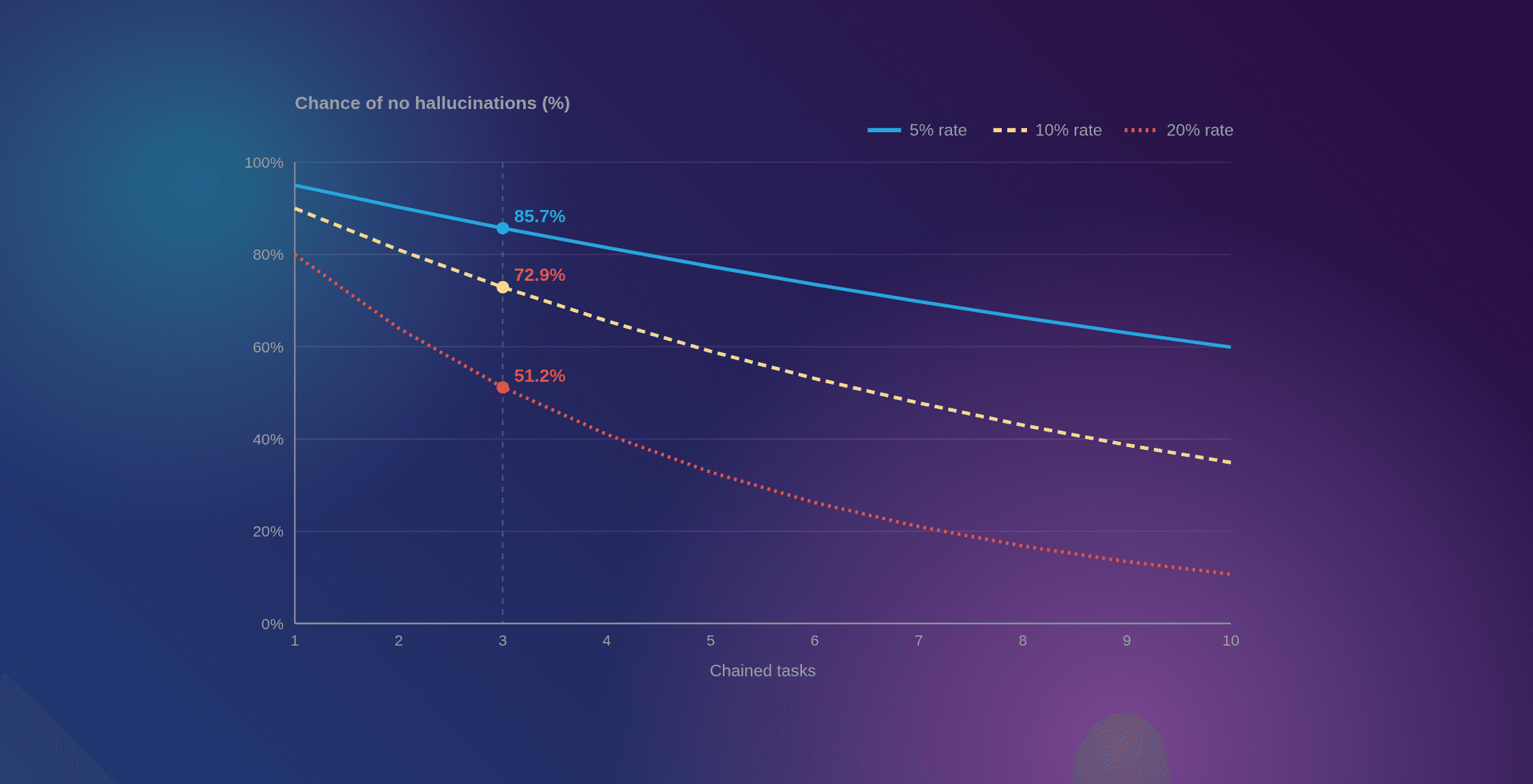
Table of Contents
Most teams discover their AI is hallucinating the hard way — a wrong number in a report that went to a client, a fabricated metric that made it into a board deck. By then, the damage is done.
The instinct is to fix the prompts. Add more instructions, tighten the guardrails, tell the model to only use verified data. Sometimes it helps. But hallucinations keep showing up, because the prompts aren't the problem. The architecture is.
This is what that actually means — and what it takes to fix it.
Why LLMs Hallucinate
To understand why standard mitigation strategies fall short, you need to understand what an LLM is actually doing when it generates a response.
Large language models are next-token predictors. They generate the most statistically plausible continuation of a sequence — not the correct answer. They have no internal mechanism for knowing when they don't know something. When asked a question, the model does not retrieve a fact and report it. It generates text that looks like a factual response based on patterns learned during training.
This is not a bug. It is the fundamental design of how these models work.
The practical implication is significant: every downstream hallucination mitigation is fighting an upstream probabilistic process. You are trying to make a system that was designed to generate plausible text reliably produce accurate data — and those are two different problems.
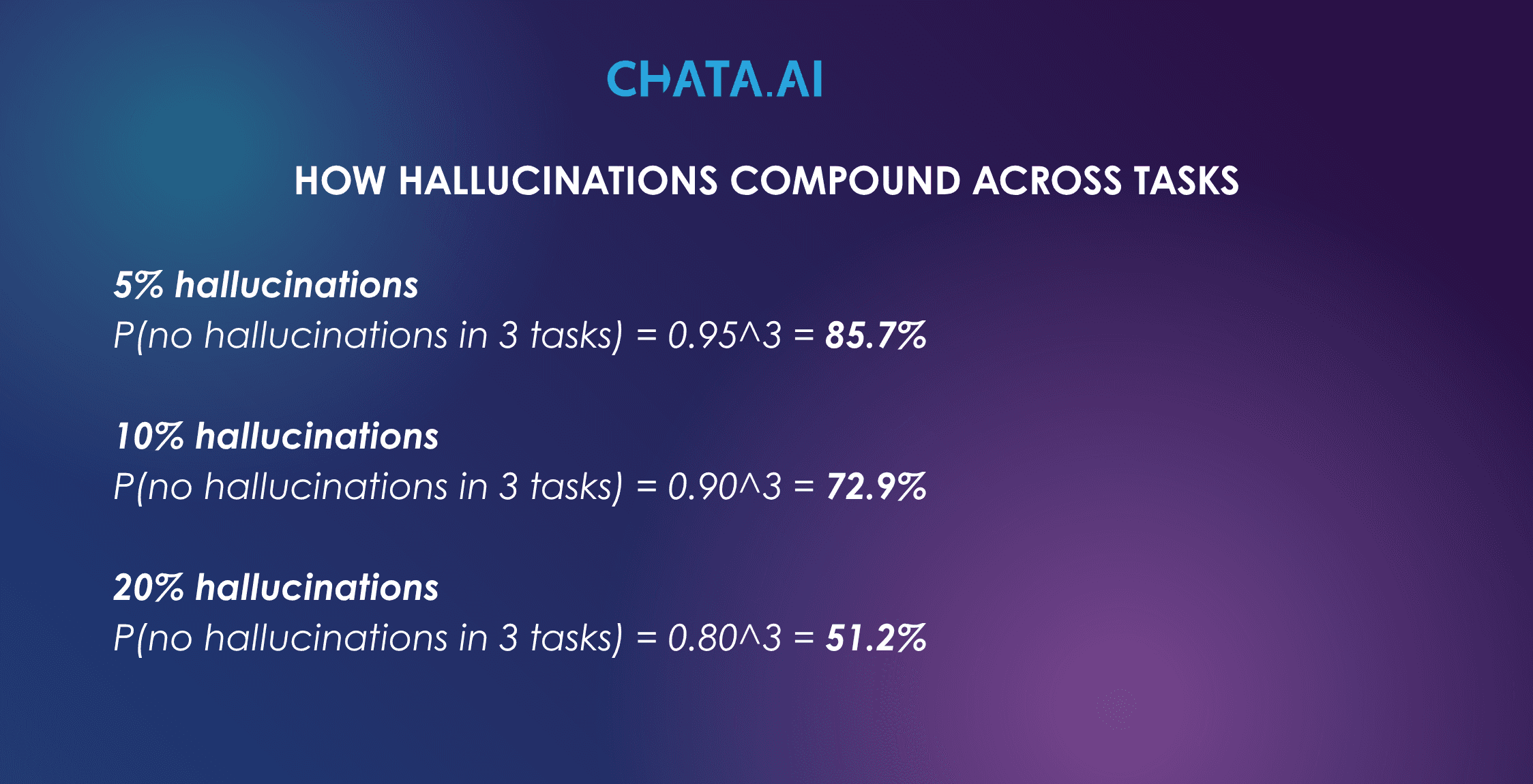
With a 5% hallucination rate, there is only an 86% chance of success across three consecutive tasks. In regulated industries, that residual error rate is not a performance benchmark — it is a liability.
LLM Hallucination Prevention Techniques: RAG, Prompt Engineering, and Output Validation
When teams discover their LLM is hallucinating in production, they typically reach for one of three approaches. Each one is a genuine attempt to solve the problem.
Prompt Engineering and System Prompts
Adding instructions to the model — "only answer based on verified data," "do not fabricate numbers," "say you don't know if you are unsure" — is the first thing most teams try. It helps, in a limited way. Clear, constraining prompts can narrow the output distribution and reduce certain categories of hallucination.
However, the model still generates text probabilistically. The instruction adjusts what kinds of responses are more or less likely — it does not change the underlying process. A confident, plausible wrong answer that technically fits within the instruction boundary will still pass through.
Retrieval-Augmented Generation (RAG)
RAG improves context by retrieving relevant documents or data chunks from an external source at query time, giving the model verified material to work from rather than relying on training data alone. For general knowledge tasks, this meaningfully reduces hallucination rates.
For structured data and analytics queries, the limitations are more acute. Retrieval misses — when the right data simply isn't surfaced — are common. Context window saturation causes the model to deprioritize key facts when too much is retrieved. And critically, the model still interprets the retrieved data. It can receive correct numbers and still draw the wrong conclusion, especially on multi-hop or numerical reasoning tasks.
RAG reduces the information gap. It does not remove the interpretation risk.
Teams that go deep on this discover the same ceiling. One engineering team cycled through four iterations — semantic layers, warehouse-direct queries, dbt-grounded models, and eventually a unified internal MCP combining tables, YAML docs, and business definitions. Each phase solved the previous problem and introduced the next one. The context gets richer; the interpretation risk doesn't go away.
Output Validation and Confidence Scoring
Post-generation checks — confidence thresholds, semantic similarity scoring, multi-agent verification — add a layer of review after the model has produced its answer. This can catch some wrong answers before they reach users.
The fundamental problem: you are using a probabilistic system to validate a probabilistic system. The most dangerous hallucinations are the ones generated with high confidence — they sound authoritative, they pass plausibility checks, and they are wrong. These are precisely the answers most likely to clear a validation layer.
The Common Thread
All three approaches share the same architectural assumption: the LLM is responsible for querying and interpreting data. They differ only in how much support they give the model before it generates an answer, or how much scrutiny they apply after.
That assumption is where the problem lives. As long as a probabilistic model is in charge of the step that requires precision, mitigation strategies will reduce hallucination rates — but they will never eliminate them.
How Chata.ai Prevents AI Hallucinations with Deterministic Architecture
Chata.ai's approach starts from a different architectural question: instead of asking "how do we make the LLM more reliable?", it asks "what should the LLM actually be responsible for?"
The answer is a two-layer architecture — deterministic first, generative second — where each layer handles only the tasks it is designed for.
1: AutoQL — Deterministic Query Translation
When a user submits a natural language question, AutoQL converts it into precise database query language and retrieves results directly from the data warehouse. The model responsible for this translation is not a general-purpose LLM. It is a custom, deterministic language model trained specifically on the customer's database schema, data types, and business logic.
The result is always the same for the same question. It is traceable to its source. It is executable against the database through a read-only connection. No interpretation, no approximation, no statistical guesswork.
The LLM is not involved in this step at all. Hallucination cannot occur here because the model responsible for querying the data was not built to generate plausible text — it was built to generate accurate queries.
2: Auto Analyze — Generative Summarization of Verified Data
Once AutoQL has returned a verified result set, the generative AI layer takes over a specific, bounded job: turning confirmed data into plain-language summaries that non-technical users can understand and act on.
Critically, the LLM at this layer is not touching the source data. It is not querying the database. It is not generating numbers or inferring figures. It receives output that has already been validated and converts it into a readable format. If a summary contains a minor imprecision in phrasing, the underlying numbers remain untouched and correct.

Why the Sequence Is Everything
The design principle that makes this work is the ordering: deterministic first, generative second.
The LLM is only involved in the step where imprecision is tolerable. The step that requires accuracy — retrieving and interpreting structured data — is handled by a system that cannot hallucinate because it does not generate probabilistic text. Hallucination risk is not reduced or managed at the query layer. It is eliminated.
This also makes the system fully auditable. Every answer can be traced back to the exact query executed and the exact data returned. That is not a feature of the AI layer — it is a structural property of the architecture.
Deterministic vs. Generative AI: Why Architecture Determines Reliability in Production
Chata.ai's architecture removes the LLM from the step that matters. The deterministic layer produces the same answer to the same question, every time. There is no drift to monitor at the data layer, no retrieval pipeline to tune, no confidence threshold to calibrate. The answer is either correct or it surfaces an error — there is no middle ground of plausible-but-wrong.
For teams operating in regulated industries, this is not a preference. CIOs and CTOs deploying AI in finance, healthcare, and government face pressure to harness AI's capabilities without introducing untraceable results. An architecture where every answer is auditable and every query is reproducible is not just more reliable — it meets a compliance standard that probabilistic systems, however well-mitigated, cannot.
The question for any production AI system handling structured data is not whether to prevent hallucinations. It is whether your architecture actually does.
Ready to see hallucination-free analytics in action? Book a demo with Chata.ai and see how AutoQL delivers verified, auditable answers from your own data warehouse.
Topics
Help teams explore data without compromising privacy.
How to Prevent LLM Hallucinations in Production AI Systems?
Published
6 min read
Topics:
Reliable AI
Table of Contents
Most teams discover their AI is hallucinating the hard way — a wrong number in a report that went to a client, a fabricated metric that made it into a board deck. By then, the damage is done.
The instinct is to fix the prompts. Add more instructions, tighten the guardrails, tell the model to only use verified data. Sometimes it helps. But hallucinations keep showing up, because the prompts aren't the problem. The architecture is.
This is what that actually means — and what it takes to fix it.
Why LLMs Hallucinate
To understand why standard mitigation strategies fall short, you need to understand what an LLM is actually doing when it generates a response.
Large language models are next-token predictors. They generate the most statistically plausible continuation of a sequence — not the correct answer. They have no internal mechanism for knowing when they don't know something. When asked a question, the model does not retrieve a fact and report it. It generates text that looks like a factual response based on patterns learned during training.
This is not a bug. It is the fundamental design of how these models work.
The practical implication is significant: every downstream hallucination mitigation is fighting an upstream probabilistic process. You are trying to make a system that was designed to generate plausible text reliably produce accurate data — and those are two different problems.
With a 5% hallucination rate, there is only an 86% chance of success across three consecutive tasks. In regulated industries, that residual error rate is not a performance benchmark — it is a liability.
LLM Hallucination Prevention Techniques: RAG, Prompt Engineering, and Output Validation
When teams discover their LLM is hallucinating in production, they typically reach for one of three approaches. Each one is a genuine attempt to solve the problem.
Prompt Engineering and System Prompts
Adding instructions to the model — "only answer based on verified data," "do not fabricate numbers," "say you don't know if you are unsure" — is the first thing most teams try. It helps, in a limited way. Clear, constraining prompts can narrow the output distribution and reduce certain categories of hallucination.
However, the model still generates text probabilistically. The instruction adjusts what kinds of responses are more or less likely — it does not change the underlying process. A confident, plausible wrong answer that technically fits within the instruction boundary will still pass through.
Retrieval-Augmented Generation (RAG)
RAG improves context by retrieving relevant documents or data chunks from an external source at query time, giving the model verified material to work from rather than relying on training data alone. For general knowledge tasks, this meaningfully reduces hallucination rates.
For structured data and analytics queries, the limitations are more acute. Retrieval misses — when the right data simply isn't surfaced — are common. Context window saturation causes the model to deprioritize key facts when too much is retrieved. And critically, the model still interprets the retrieved data. It can receive correct numbers and still draw the wrong conclusion, especially on multi-hop or numerical reasoning tasks.
RAG reduces the information gap. It does not remove the interpretation risk.
Teams that go deep on this discover the same ceiling. One engineering team cycled through four iterations — semantic layers, warehouse-direct queries, dbt-grounded models, and eventually a unified internal MCP combining tables, YAML docs, and business definitions. Each phase solved the previous problem and introduced the next one. The context gets richer; the interpretation risk doesn't go away.
Output Validation and Confidence Scoring
Post-generation checks — confidence thresholds, semantic similarity scoring, multi-agent verification — add a layer of review after the model has produced its answer. This can catch some wrong answers before they reach users.
The fundamental problem: you are using a probabilistic system to validate a probabilistic system. The most dangerous hallucinations are the ones generated with high confidence — they sound authoritative, they pass plausibility checks, and they are wrong. These are precisely the answers most likely to clear a validation layer.
The Common Thread
All three approaches share the same architectural assumption: the LLM is responsible for querying and interpreting data. They differ only in how much support they give the model before it generates an answer, or how much scrutiny they apply after.
That assumption is where the problem lives. As long as a probabilistic model is in charge of the step that requires precision, mitigation strategies will reduce hallucination rates — but they will never eliminate them.
How Chata.ai Prevents AI Hallucinations with Deterministic Architecture
Chata.ai's approach starts from a different architectural question: instead of asking "how do we make the LLM more reliable?", it asks "what should the LLM actually be responsible for?"
The answer is a two-layer architecture — deterministic first, generative second — where each layer handles only the tasks it is designed for.
1: AutoQL — Deterministic Query Translation
When a user submits a natural language question, AutoQL converts it into precise database query language and retrieves results directly from the data warehouse. The model responsible for this translation is not a general-purpose LLM. It is a custom, deterministic language model trained specifically on the customer's database schema, data types, and business logic.
The result is always the same for the same question. It is traceable to its source. It is executable against the database through a read-only connection. No interpretation, no approximation, no statistical guesswork.
The LLM is not involved in this step at all. Hallucination cannot occur here because the model responsible for querying the data was not built to generate plausible text — it was built to generate accurate queries.
2: Auto Analyze — Generative Summarization of Verified Data
Once AutoQL has returned a verified result set, the generative AI layer takes over a specific, bounded job: turning confirmed data into plain-language summaries that non-technical users can understand and act on.
Critically, the LLM at this layer is not touching the source data. It is not querying the database. It is not generating numbers or inferring figures. It receives output that has already been validated and converts it into a readable format. If a summary contains a minor imprecision in phrasing, the underlying numbers remain untouched and correct.
Why the Sequence Is Everything
The design principle that makes this work is the ordering: deterministic first, generative second.
The LLM is only involved in the step where imprecision is tolerable. The step that requires accuracy — retrieving and interpreting structured data — is handled by a system that cannot hallucinate because it does not generate probabilistic text. Hallucination risk is not reduced or managed at the query layer. It is eliminated.
This also makes the system fully auditable. Every answer can be traced back to the exact query executed and the exact data returned. That is not a feature of the AI layer — it is a structural property of the architecture.
Deterministic vs. Generative AI: Why Architecture Determines Reliability in Production
Chata.ai's architecture removes the LLM from the step that matters. The deterministic layer produces the same answer to the same question, every time. There is no drift to monitor at the data layer, no retrieval pipeline to tune, no confidence threshold to calibrate. The answer is either correct or it surfaces an error — there is no middle ground of plausible-but-wrong.
For teams operating in regulated industries, this is not a preference. CIOs and CTOs deploying AI in finance, healthcare, and government face pressure to harness AI's capabilities without introducing untraceable results. An architecture where every answer is auditable and every query is reproducible is not just more reliable — it meets a compliance standard that probabilistic systems, however well-mitigated, cannot.
The question for any production AI system handling structured data is not whether to prevent hallucinations. It is whether your architecture actually does.
Ready to see hallucination-free analytics in action? Book a demo with Chata.ai and see how AutoQL delivers verified, auditable answers from your own data warehouse.
More Updates